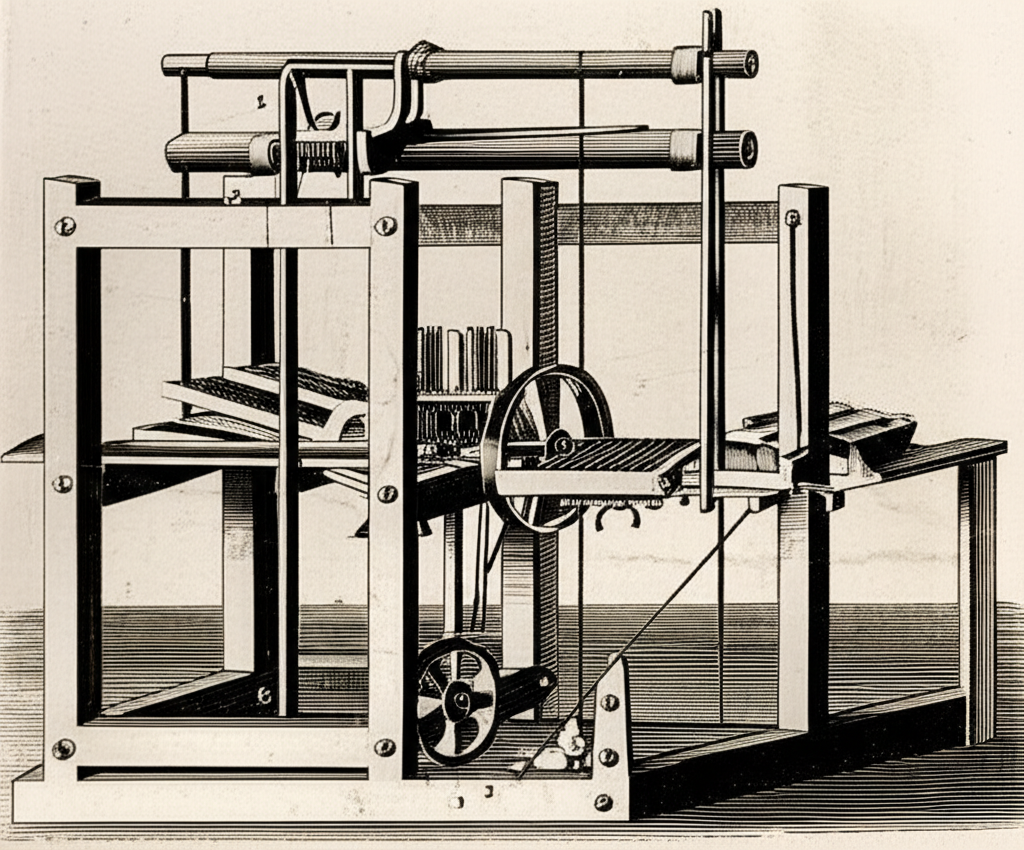
The invention of the power loom by Edmund Cartwright in 1785 marked a pivotal, if initially flawed, development in the mechanization of the textile industry. Cartwright, a clergyman with minimal engineering background, conceived of the device after observing the efficiency of automated spinning machinery. His objective was to create a corresponding machine for weaving that would balance the production of yarn with the output of cloth. The first prototype, however, proved to be commercially unviable, a cumbersome apparatus that required significant physical force to operate and produced inferior fabric.
Recognizing the loom’s mechanical shortcomings, Cartwright pursued a strategy of iterative improvement. Subsequent patents introduced critical optimizations, such as mechanisms to stop the loom automatically when a thread broke and a more effective system for dressing the warp. These refinements were crucial steps in transforming the power loom from a theoretical concept into a practical industrial machine. Although Cartwright’s own manufacturing ventures were not successful, his foundational design established the mechanical principles necessary for automated weaving. His pioneering work was later refined by other engineers, whose enhancements ultimately led to the loom’s widespread adoption and its profound impact on the labor landscape of the Industrial Revolution.