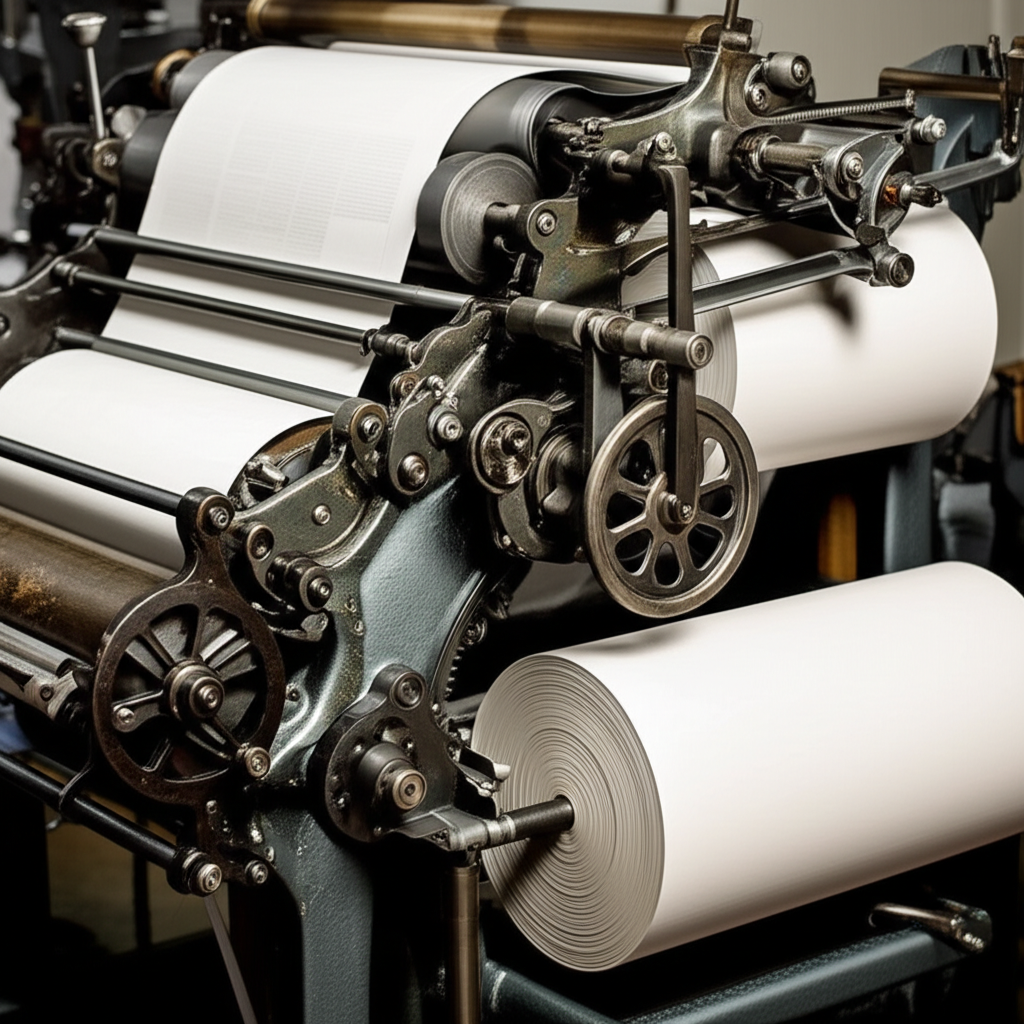
The invention of the Rotary Printing Press by Richard March Hoe in 1843 marked a decisive pivot in the mechanics of information dissemination. Prior to this innovation, the circulation of daily journals was severely constrained by the physical limitations of the flatbed press. The reciprocating motion required for flatbed printing created an unavoidable bottleneck, capping production speeds and rendering the rapid distribution of breaking news a logistical impossibility for burgeoning urban populations.
Hoe’s strategic breakthrough lay in the architecture of the machine itself. By securing the type onto a revolving cylinder rather than a static flat bed, the press could operate with continuous motion. This optimization allowed sheets of paper to be fed through the machine with far greater velocity. The introduction of the “Lightning Press” demonstrated this efficiency, increasing output from a few hundred impressions to tens of thousands per hour.
The implications of this mechanical advancement extended beyond mere speed; it fundamentally altered the economics of the news industry. The reduction in production time and cost facilitated the rise of the Penny Press, making newspapers affordable for the working class. Consequently, the news shifted from a luxury commodity for the elite into a mass-market product. This era of industrial printing established the foundation for modern mass media, proving that the optimization of mechanical speed was the catalyst for the democratization of information.