The establishment of Fasil Ghebbi in 1636 by Emperor Fasilides marked a decisive departure from the itinerant royal camps that had characterized Ethiopian governance for centuries. By selecting Gondar as a permanent capital, the Emperor executed a strategic consolidation of political and religious authority. The site was chosen not merely for its temperate climate, but for its defensible topography and proximity to vital trade routes linking the highlands to the Sudan and the Red Sea.
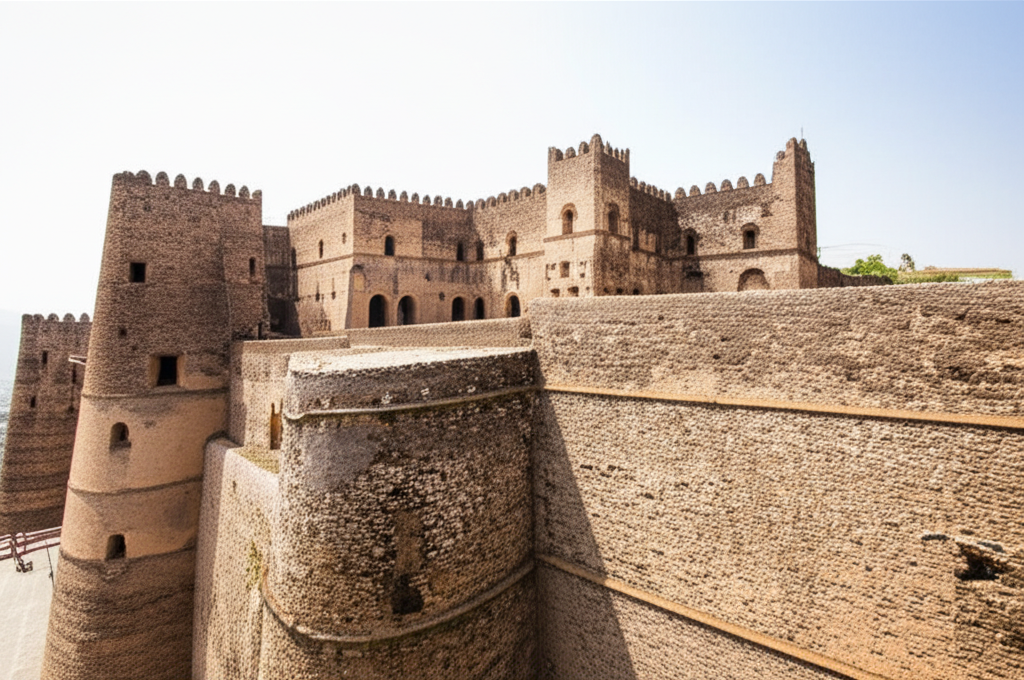
The fortress complex itself, encompassing roughly 70,000 square meters, demonstrated a sophisticated understanding of structural engineering and aesthetic syncretism. Builders utilized locally quarried basalt and volcanic tuff held together with lime mortar, creating edifices capable of withstanding both siege and time. The architectural style reflected a deliberate fusion of diverse influences:
Axumite structural traditions
Portuguese-Baroque aesthetics
* Indian and Arab decorative elements
This unique “Gondarine” style served as a visual manifestation of the empire’s cosmopolitan reach. The central keep, Fasilides’ Castle, featured massive towers and crenulated battlements that optimized defensive sightlines while projecting imperial dominance over the surrounding landscape. Subsequent rulers expanded the enclosure, adding their own structures, yet the unifying defensive perimeter remained the defining feature.
The construction of the curtain wall, pierced by twelve strategic gates, transformed the royal compound into an administrative citadel. This enclosure effectively insulated the monarch from civil unrest while centralizing the machinery of state within a fortified nucleus, ensuring the continuity of the Solomonic dynasty during a tumultuous era.