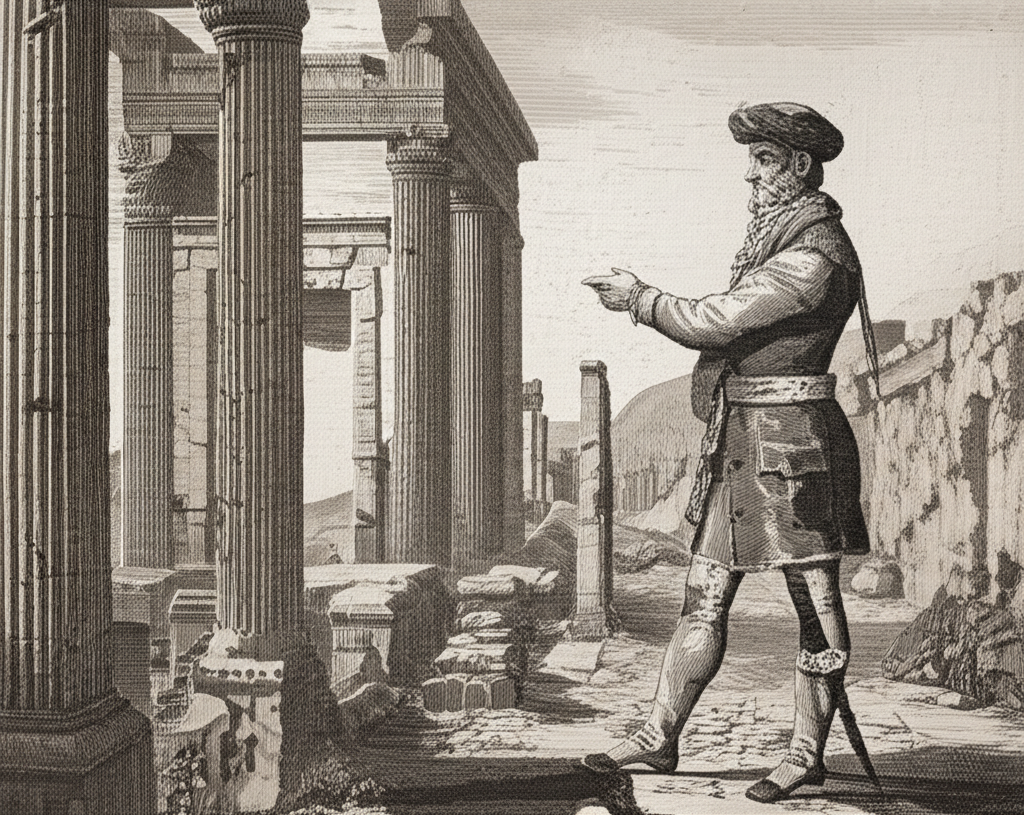
The Royal Danish Arabia Expedition (1761-1767) is often remembered for its tragic losses, yet its most enduring legacy was secured by its sole survivor, the cartographer Carsten Niebuhr. His survey of the Achaemenid ruins of Persepolis in 1765 represented a pivotal moment in the study of the ancient Near East, transitioning the practice from antiquarian curiosity to a more disciplined science.
Unlike previous visitors who rendered romanticized or inaccurate impressions, Niebuhr applied a systematic and objective methodology to his work. Over a period of three weeks, he undertook the arduous task of precisely measuring the structures and, most importantly, creating exceptionally accurate transcriptions of the cuneiform inscriptions. He recognized these wedge-shaped marks not as mere decoration but as a form of writing that held historical data. His strategy was one of careful preservation, creating a reliable record for future analysis.
The profound impact of this approach was not realized for several decades. Niebuhr’s faithful copies of the trilingual inscriptions provided European philologists with the first dependable dataset of cuneiform script. This material proved to be the indispensable key for scholars like Georg Friedrich Grotefend, who used Niebuhr’s plates to achieve the first successful decipherments of Old Persian. Niebuhr’s contribution was therefore not simply the discovery of a site, but the methodical documentation that unlocked its secrets for generations to come.