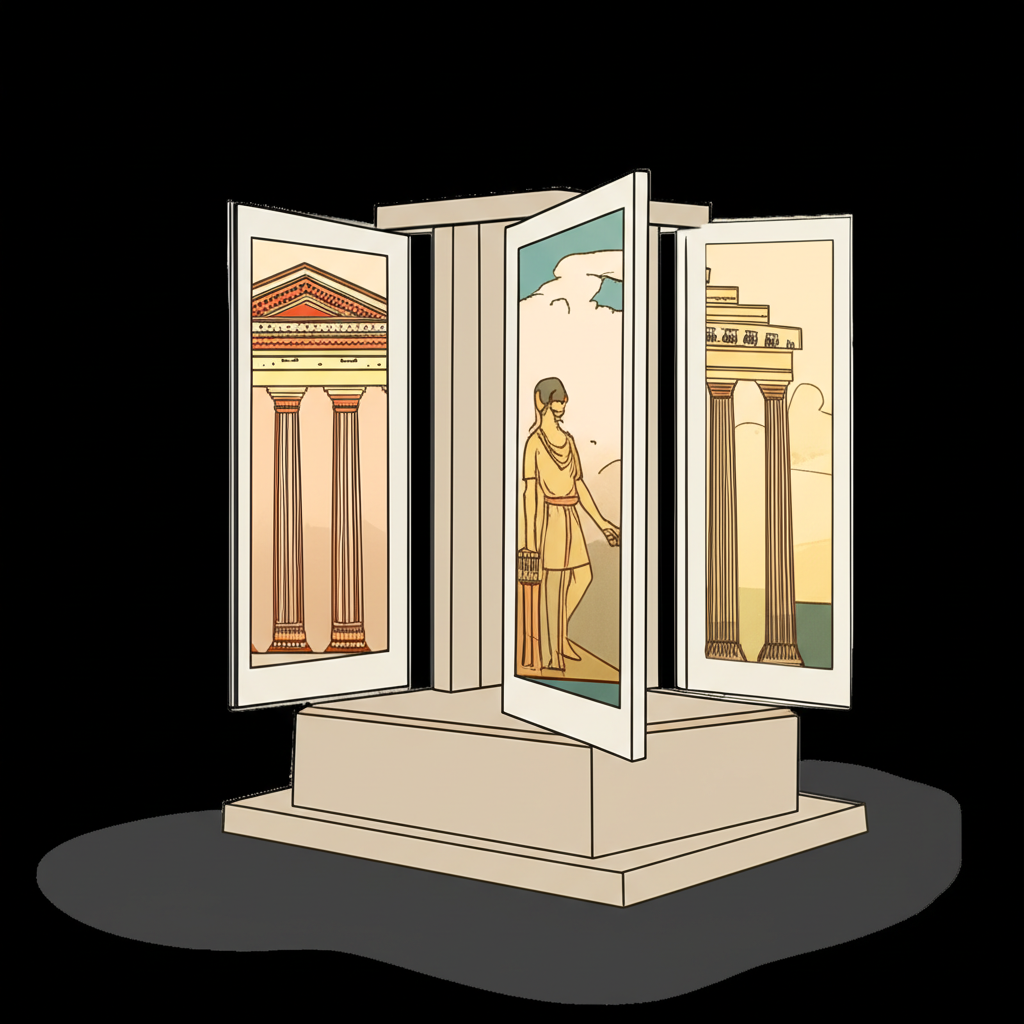
The introduction of the Periaktoi marked a pivotal evolution in the engineering of the ancient Greek stage. Prior to this mechanical intervention, the narrative flow within the Theatre of Dionysus was often constrained by the static nature of the architectural background. To circumvent the limitations of the unyielding stone façade, engineers and set designers devised these revolving triangular prisms, strategically positioned at the lateral entrances of the Skene structure.
From a strategic perspective, the utility of this device extended beyond mere decoration; it facilitated a rapid optimization of narrative time. By painting a distinct scene upon each of the three faces, stagehands could execute instantaneous transitions between disparate locations—such as a shift from a maritime harbor to a sacred temple—without disrupting the dramatic momentum. This rotation allowed the playwright to maintain the audience’s immersion while adhering to the rigorous demands of the plot, effectively condensing time and space through mechanical ingenuity.
Furthermore, the deployment of these prisms introduced a codified visual language to the performance. Historical analysis suggests a standardized approach to the imagery was often employed to signal genre shifts:
One face depicted the tragic grandeur of palaces or columns.
A second face displayed the rustic, natural elements associated with satyr plays.
* The third face illustrated the domestic or municipal settings typical of comedy.
This system provided the audience with immediate visual cues regarding the tone of the ensuing scene. Ultimately, the integration of such machinery demonstrated a sophisticated understanding of spatial economy, proving that the ancient Greeks prioritized technical precision as a fundamental pillar of their theatrical tradition.