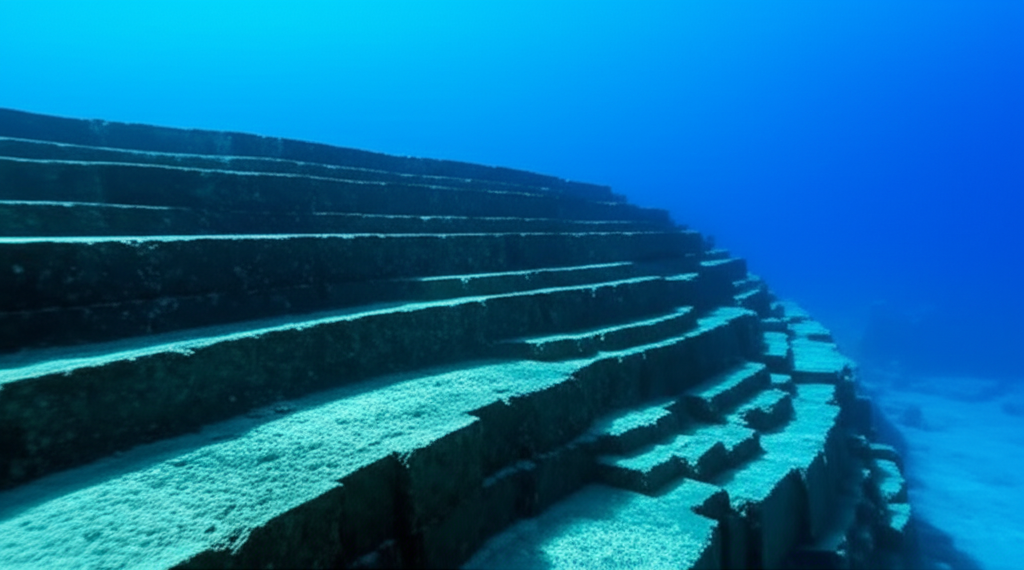
Since its discovery in 1987, the submerged rock formation off the coast of the Ryukyu Islands ignited a fierce debate within the archaeological and geological communities. Known as the Yonaguni Monument, this massive underwater structure presented a series of right angles, distinct terraces, and pillar-like features that defied conventional understandings of natural erosion. To the observer, the site appeared to be the remnants of a lost civilization, submerged by rising sea levels following the last Ice Age.
Marine geologist Masaaki Kimura championed the theory that the site was an ancient monolith, possibly a fortress or temple complex. His analysis pointed to specific anomalies, such as the appearance of carved steps and the “Loop Road,” which suggested deliberate engineering rather than random tectonic activity. If proven to be artificial, the monument would necessitate a radical rewriting of human history, suggesting advanced stonemasonry existed in Japan long before the Jomon period.
Conversely, skeptical scholars, led by geologist Robert Schoch, argued that the straight lines were the result of the natural fracturing of sandstone. This rock type tends to break along planes, creating the illusion of man-made architecture when subjected to currents and tectonic shifts over millennia. Schoch noted that the “carvings” lacked the consistency of human tools and were indistinguishable from nearby natural formations.
Ultimately, the classification of the Yonaguni Monument remained unresolved. It stood either as a testament to a forgotten chapter of human ingenuity or a remarkable example of nature’s ability to mimic order. The site continues to serve as a pivotal case study in the challenge of distinguishing between geological anomalies and genuine archaeological artifacts.