
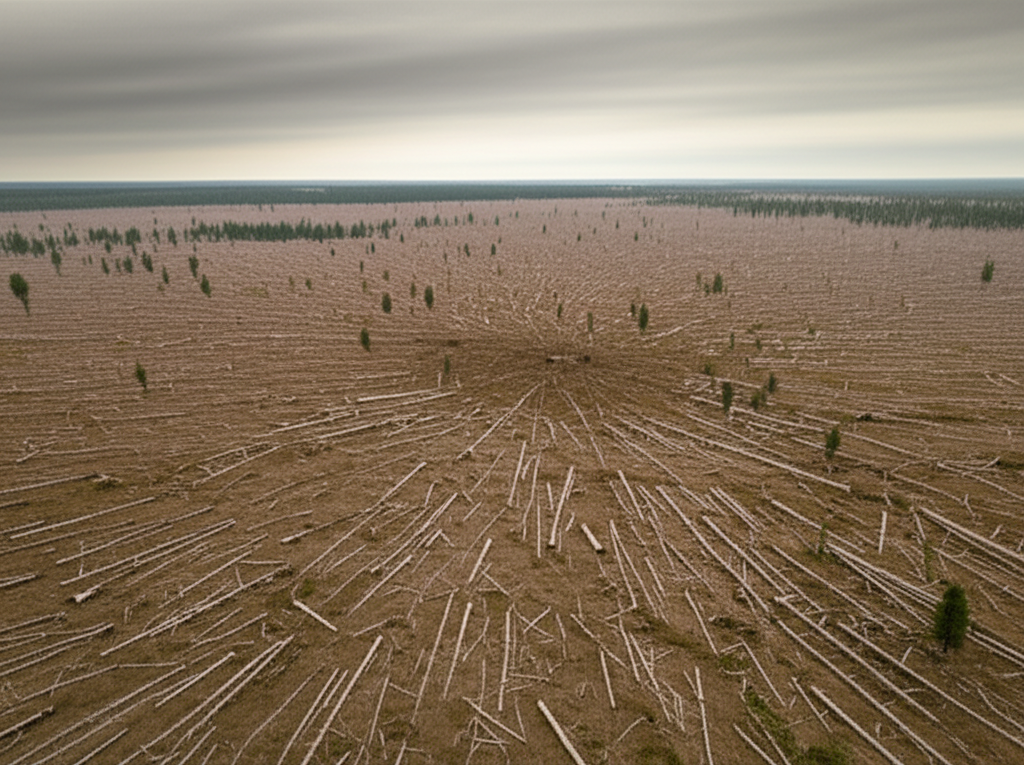
On the morning of June 30, 1908, the remote wilderness of the Podkamennaya Tunguska River basin experienced a disaster of unprecedented scale. Witnesses positioned hundreds of kilometers away reported observing a column of blue light traversing the sky, followed immediately by a sound resembling heavy artillery fire. The subsequent explosion, which history would record as the Tunguska Event, leveled an estimated 80 million trees over an area spanning 2,150 square kilometers. The blast, later calculated to be nearly a thousand times more powerful than the atomic bomb dropped on Hiroshima, flattened the taiga in a distinct radial pattern, with the trunks pointing directly away from the epicenter.
Due to the extreme isolation of the region and the political turbulence within early 20th-century Russia, the first scientific expedition did not reach the site until 1927. Led by mineralogist Leonid Kulik, the team discovered a puzzling absence of an impact crater. This anomaly baffled early researchers and fueled decades of speculation regarding the nature of the object. Subsequent analysis determined that the devastation resulted from an atmospheric airburst rather than a direct collision. A stony meteoroid or cometary fragment, traveling at extreme velocity, disintegrated under immense pressure and heat at an altitude of approximately five to ten kilometers.
The Tunguska Event remains the most significant impact event on Earth in recorded history. It serves as a critical case study for modern astronomers regarding the potential threat of near-Earth objects. The preservation of the fallen forest provided a unique data set, allowing scientists to model the trajectory and energy of the impactor with increasing precision. This occurrence demonstrated that catastrophic damage could occur without the object striking the ground, fundamentally altering the strategic understanding of planetary defense and risk assessment.


