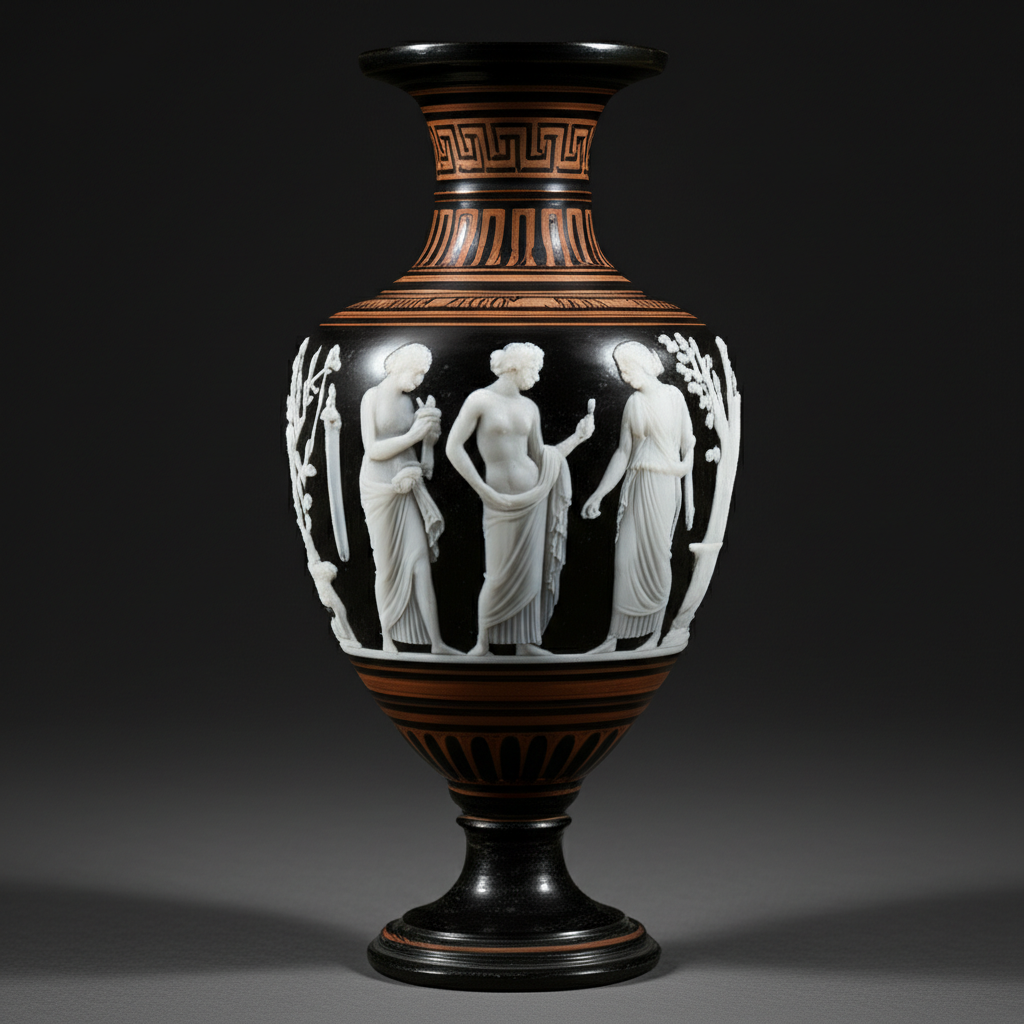
The Portland Vase stands as the preeminent surviving example of Roman cameo glass, representing the apex of glassworking capabilities during the reign of Emperor Augustus. Scholars have long analyzed the artifact not merely for its aesthetic value, but for the sophisticated engineering required to fuse two distinct layers of glass without inducing catastrophic stress fractures. The vessel, composed of a deep cobalt blue body encased in a layer of opaque white glass, demonstrated a mastery of thermal expansion properties that remained unmatched for centuries.
The manufacturing strategy relied on the dip-overlay technique, followed by a rigorous subtractive process. Once the layers were fused and cooled, the artisan utilized methods akin to gem carving to grind away the white outer layer. This demanded absolute precision; the cutter had to calculate the depth of relief to utilize the translucency of the thinning white glass, creating shadows and muscular definition against the blue background. The resulting iconography, widely believed to depict the myth of Peleus and Thetis, showcased a manipulation of light that transformed rigid glass into fluid narrative scenes.
Its provenance significantly altered the trajectory of European decorative arts. Following its acquisition by the Duchess of Portland in 1784, the vase was loaned to the British Museum, where it served as the primary model for Josiah Wedgwood’s ceramic reproductions. The vandalism of the vase in 1845 necessitated a complex reconstruction, a forensic process that further revealed the technical prowess of the original Roman craftsmen. The artifact remains a testament to an era where imperial ambition fueled the optimization of artistic technologies.