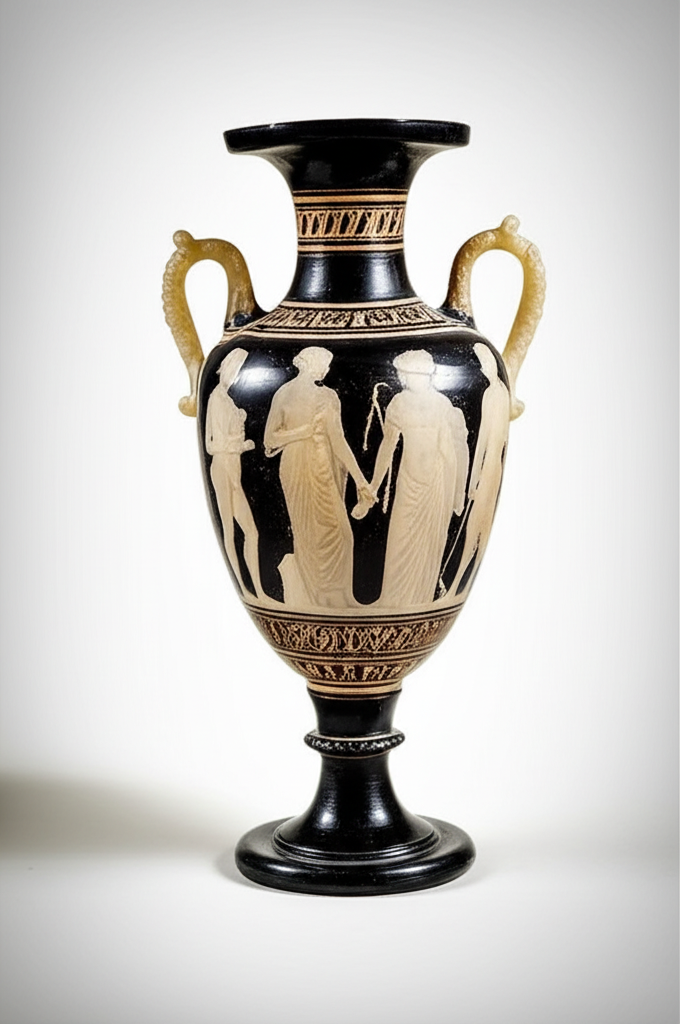
The Portland Vase emerged not merely as a decorative vessel, but as the crowning achievement of Roman luxury manufacturing, likely crafted during the reign of Augustus. While the invention of glassblowing revolutionized efficiency, this artifact represented the deliberate rejection of speed in favor of Cameo Glass virtuosity. The historical significance of the piece lay in the convergence of two distinct disciplines: the pyrotechnic chemistry of the glassmaker and the subtractive precision of the gem cutter.
The structural integrity of the vase depended on the successful execution of the Dip-Overlay technique. Artisans fused a layer of opaque white glass over a dark cobalt blue core, a process fraught with peril due to the potentially disparate coefficients of expansion between the two mixtures. The fact that the layers did not shear apart upon cooling indicated an advanced empirical understanding of material properties and batch composition. This chemical optimization allowed the vessel to survive the intense mechanical stress of subsequent cold working.
Following the initial formation, the vase underwent Lapidary carving, utilizing the same abrasive wheels and drills employed for hardstones like onyx or agate. The artist did not simply engrave the surface but sculpted the white layer to varying depths. By thinning the glass to near-translucency, the carver manipulated light and shadow, creating a perception of three-dimensional depth unavailable in monochromatic wares. Ultimately, the Portland Vase documented a brief historical moment where Roman glassworking transcended utilitarian function to rival, and perhaps surpass, the prestige of semi-precious stone carving.