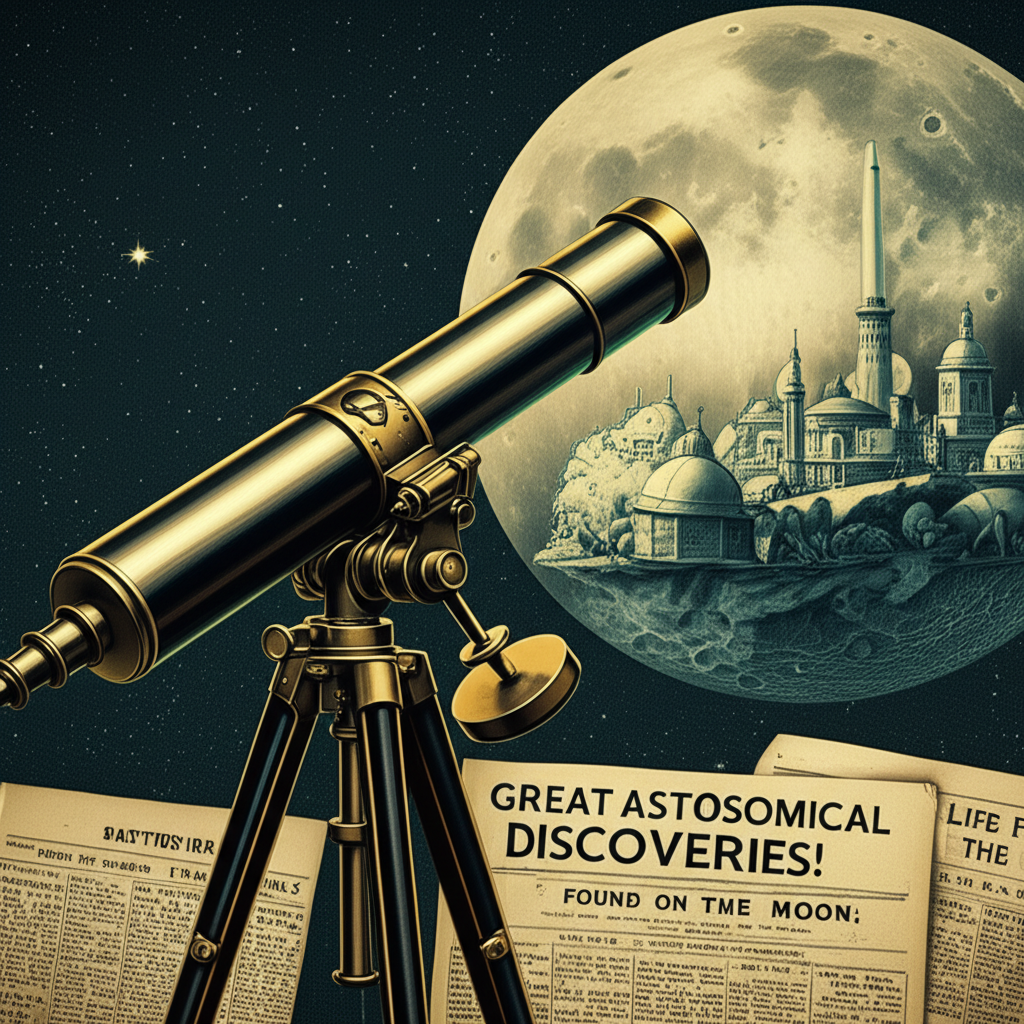
In August 1835, the media landscape of New York City witnessed a defining moment in the history of mass communication, now recorded as the Great Moon Hoax. Published by The Sun, an emerging penny press newspaper, a series of six articles purported to reprint findings from the Edinburgh Journal of Science. The texts claimed to document the recent astronomical discoveries of Sir John Herschel, who had allegedly established a powerful new telescope at the Cape of Good Hope to observe the lunar surface.
The articles offered a highly descriptive narrative of a thriving lunar ecology. The reporter, Richard Adams Locke, constructed a detailed world featuring amethyst crystals, herds of bison-like creatures, and blue unicorns. However, the most captivating claim involved the observation of Vespertilio-homo, or winged bat-men, who supposedly engaged in conversation and built temples. Locke strategically employed a dense, pseudo-scientific writing style, blending technical jargon with fantastical imagery to bypass the skepticism of the lay reader.
From a strategic perspective, the fabrication was a masterstroke of circulation optimization. By leveraging the authority of a respected scientist, The Sun dramatically increased its readership, achieving a circulation of nearly 19,000 copies—a figure that rivaled the largest papers in the world at that time.
The event provided a significant insight into the mechanics of the penny press. It demonstrated that entertainment and sensationalism could drive sales more effectively than dry political discourse. Even after the story was exposed as a fabrication, the public reaction remained largely comprised of amusement rather than outrage, solidifying the hoax as a successful experiment in audience engagement and narrative control.