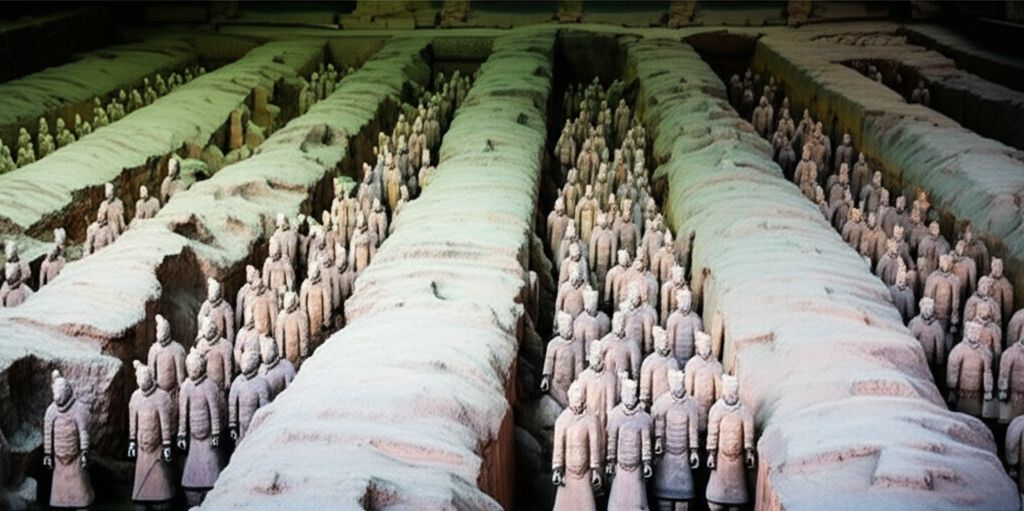
In March 1974, amidst a severe drought in the Lintong District, a group of farmers sinking a well struck fragments of hardened clay rather than water. This inadvertent excavation unveiled the Terracotta Army, a subterranean garrison that had stood vigil over the necropolis of Emperor Qin Shi Huang for more than two millennia. The discovery immediately commanded global attention, not merely for the scale of the find, but for the insight it provided into the military and spiritual strategies of the Qin Dynasty.
The organization of the pits reflected a sophisticated understanding of warfare and imperial administration. The layout mirrored a functional battle formation, with vanguards, flankers, and rear guards positioned to defend the Emperor in the afterlife. This immense project signaled a strategic evolution in funerary rites; rather than adhering to the archaic practice of mass human sacrifice, the Emperor utilized ceramic effigies. This decision allowed the state to preserve its living military manpower while ensuring the ruler’s eternal protection.
Analysis of the figures revealed a highly optimized system of mass production. Artisans employed modular construction, assembling standardized body parts before hand-carving individual facial features to simulate a diverse, living force. Although the vibrant pigments oxidized rapidly upon exposure to the modern atmosphere, the unearthed warriors remain a testament to the absolute power and organizational capacity required to manifest such a monumental vision of immortality.