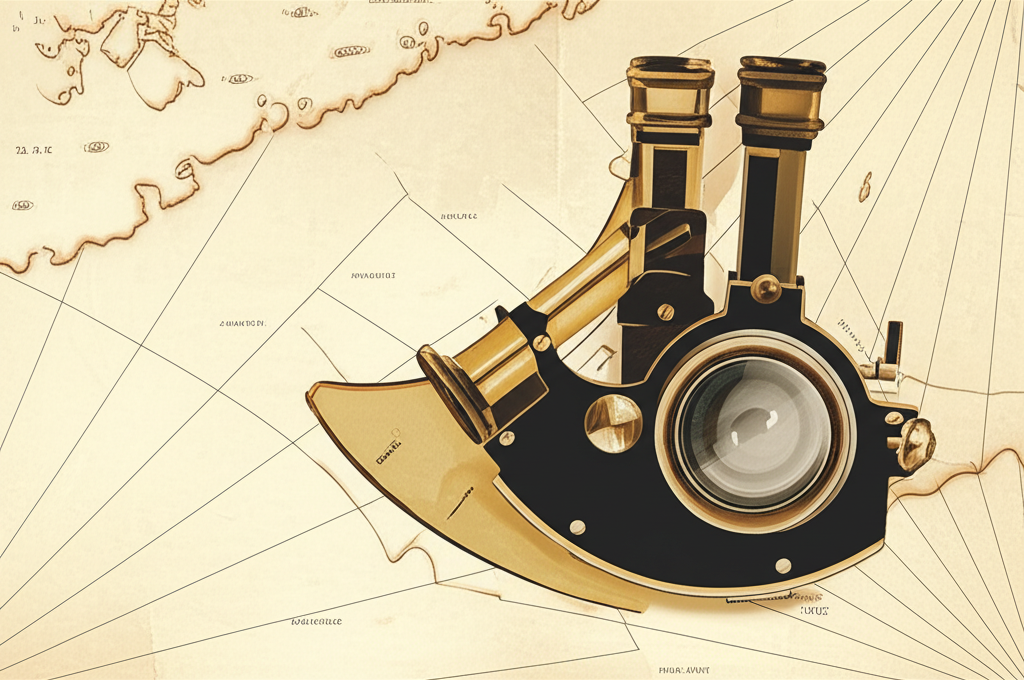
The advent of the sextant in the mid-18th century represented a profound shift in the science of maritime navigation. Its introduction rendered previous instruments, such as the quadrant and astrolabe, largely obsolete for open-ocean voyages by solving the critical problem of obtaining an accurate reading from an unstable platform.
The core strategic advantage of the sextant lay in its double-mirror system. This design allowed a navigator to bring the image of a celestial body, such as the sun or a star, into alignment with the horizon. Because both objects were viewed simultaneously, the measurement was unaffected by the ship’s motion. This innovation permitted a level of precision that was previously impossible, transforming celestial navigation from an approximation into a far more reliable discipline.
This newfound accuracy was instrumental in mastering the determination of longitude. When used in conjunction with a marine chronometer or the lunar distance method, the sextant enabled mariners to fix their position with confidence, far from any sight of land. Consequently, voyages became more direct, predictable, and safer. The optimization of sea routes reduced travel times and commercial risk, directly fueling the expansion of global trade and empire during the Age of Sail. The instrument remained the cornerstone of sea travel until the widespread adoption of electronic navigation systems in the 20th century.