
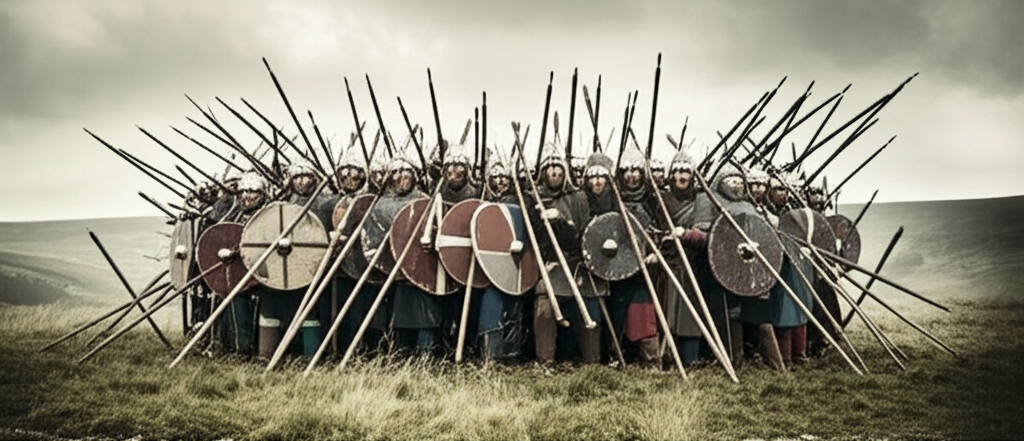
The deployment of the schiltron during the Scottish Wars of Independence represented a significant shift in medieval infantry tactics, challenging the long-standing dominance of heavy cavalry. Initially, under the stewardship of William Wallace, the formation functioned primarily as an immobile fortress. Soldiers formed hollow circles or ovals, bracing the bases of their long spears into the earth to create an impenetrable hedge of steel designed to absorb the kinetic energy of a mounted charge.
While effective against the initial shock of cavalry, this static arrangement exposed a critical strategic flaw during the Battle of Falkirk. Once the enemy horsemen were halted, the stationary Scots became easy targets for English missile troops. The formation lacked the capacity to maneuver out of range or launch a counter-offensive without breaking their ranks, ultimately leading to their encirclement and defeat.
The true optimization of this tactic emerged under King Robert the Bruce. Recognizing the limitations of a purely defensive stance, Bruce instituted rigorous drilling to cultivate discipline and cohesion. By the decisive Battle of Bannockburn, the schiltron had evolved from a passive circle into a rectilinear, mobile unit capable of aggressive maneuvers.
This strategic adaptation allowed the Scots to dictate the terms of engagement:
Mobile formations pressed the English cavalry into the marshes, negating their speed and maneuverability.
The synchronized advance compressed the enemy line, denying them the space required to deploy their archers effectively.
Through this evolution, the spear formation ceased to be merely a desperate shield and became a precise mechanism of victory, proving that disciplined infantry could dismantle superior armored might through terrain management and offensive pressure.


