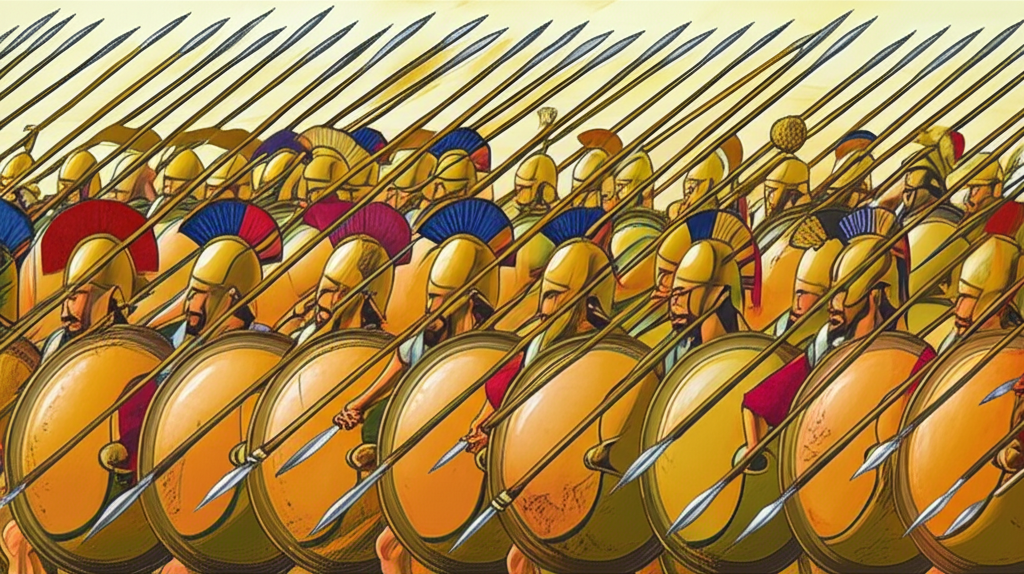
Under the military reforms initiated by Philip II, the Macedonian infantry underwent a radical transformation that rendered the traditional Greek hoplite warfare obsolete. Central to this evolution was the adoption of the sarissa, a pike measuring between four and six meters in length. Unlike the shorter spears employed by southern city-states, the sarissa allowed Macedonian soldiers to engage opponents long before they could close the distance. This equipment necessitated a two-handed grip, requiring the abandonment of the large hoplite shield in favor of a smaller rimless shield strapped to the shoulder, thereby sacrificing individual protection for overwhelming collective reach.
The tactical efficacy of the phalanx was realized through the syntagma, a formation of 256 men that prioritized density and mechanical cohesion. The front five ranks lowered their pikes horizontally, creating an impenetrable wall of iron points that projected well beyond the first line. This arrangement served two distinct purposes:
It deterred frontal cavalry charges by presenting a dense thicket of spearheads.
It neutralized shorter-ranged infantry, forcing them to navigate a lethal zone before engaging the Macedonians.
While the rear ranks could not engage directly, they angled their spears upward to deflect incoming projectiles and physically pressed forward, adding inexorable momentum to the advance.
However, historical analysis suggests the phalanx was rarely designed to secure victory in isolation. Instead, it functioned as the anchor in the Hammer and Anvil doctrine. The infantry acted as the anvil, pinning the enemy center and denying them maneuverability. Once the opposing line was fixed in place, the mobile Companion Cavalry acted as the hammer, striking the flanks or rear to deliver the decisive blow. This reliance on combined arms covered the phalanx’s inherent vulnerability to flanking maneuvers and uneven terrain.