
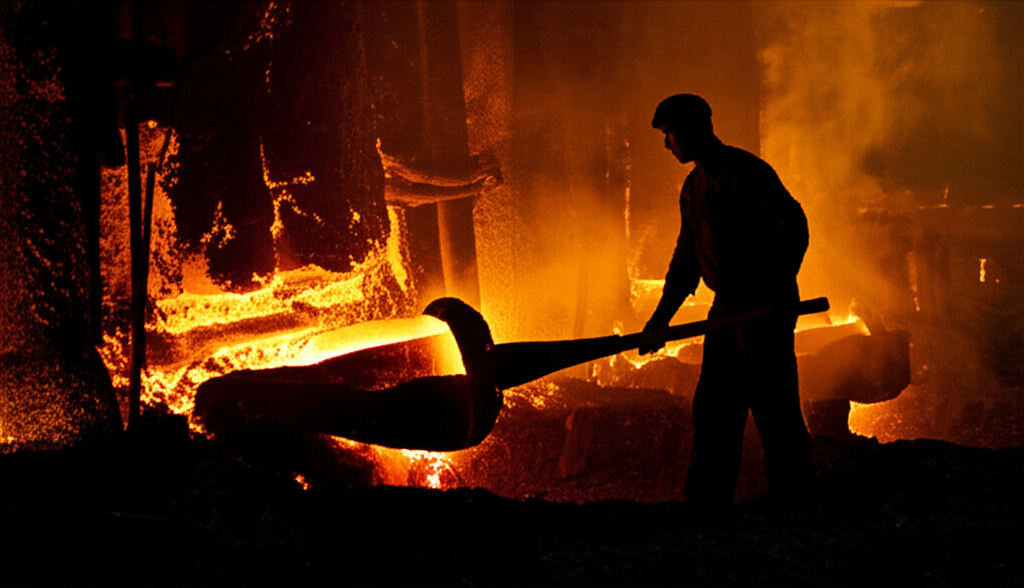
Within the complex hierarchy of the nineteenth-century ironworks, the Iron Puddler occupied a unique stratum of industrial aristocracy. Unlike the unskilled laborers surrounding him, the puddler possessed an intuitive, almost alchemical grasp of metallurgy, tasked with managing the volatile transformation of brittle pig iron into malleable wrought iron. This role required not merely brute force, but a strategic application of thermal management within the reverberatory furnace, where the fuel and ore remained separated to prevent contamination.
The optimization of the puddling process relied entirely on the artisan’s ability to sustain and manipulate the “wet puddling” technique. As the furnace temperature rose, the puddler agitated the molten charge with a long iron rabble. This vigorous stirring facilitated the oxidation of carbon and other impurities, a chemical reaction manifested by a violent boiling of the metal. The critical insight lay in judging the viscosity of the iron by eye; as the carbon burned off, the melting point rose, causing the iron to thicken into a pasty consistency.
Success depended on the puddler’s endurance during this solidification phase. He gathered the purifying iron into spongy masses, known as puddle balls, while simultaneously working to expel the liquid slag. These balls were then extracted for shingling, a hammering process that forged the iron into a coherent structure. The toll of such labor was absolute; the extreme heat and physical exertion resulted in severely shortened life expectancies, yet the puddler’s specialized skill remained the linchpin of high-quality iron production until the advent of the Bessemer process.
