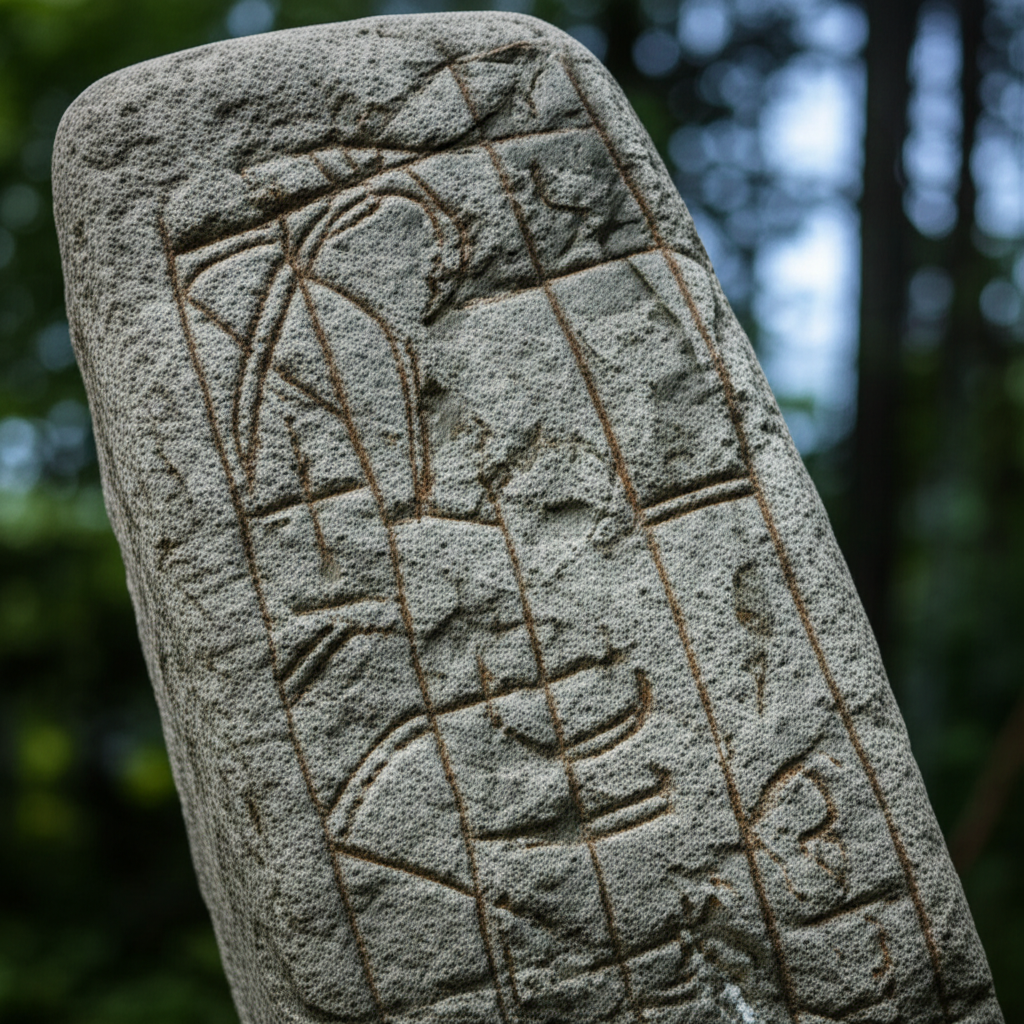
In the late autumn of 1898, a Swedish immigrant named Olof Öhman unearthed a heavy slab of greywacke entangled within the root system of an aspen tree near Kensington, Minnesota. This object, which came to be distinguished as the Kensington Runestone, bore a lengthy carved text purporting to document a desperate journey of exploration deep into the North American interior long before the arrival of Christopher Columbus.
The inscription described a combined party of eight Goths and twenty-two Norwegians on an expedition from Vinland to the West. The carving was explicitly dated to the year 1362, a temporal claim that immediately challenged the established chronology of European presence in the New World. The discovery necessitated a re-evaluation of medieval maritime capabilities and potential trans-Atlantic routes, yet the stone faced immediate skepticism from the academic community.
Rigorous scrutiny by philologists exposed significant linguistic anomalies within the text. The inscription exhibited a curious amalgamation of linguistic forms, blending medieval characters with grammar and vocabulary that arguably reflected a nineteenth-century vernacular rather than the Old Swedish or Old Norwegian dialects prevalent in the fourteenth century. Furthermore, the inscription’s pristine condition, despite its alleged age, raised doubts regarding its centuries-long exposure to the elements.
Despite the prevailing scholarly consensus classifying the artifact as a modern fabrication—likely a product of the nineteenth-century revival of interest in Viking culture—the stone persisted as a subject of intense regional debate. It became a focal point for arguments concerning pre-Columbian contact, yet the absence of corroborating archaeological evidence in the Upper Midwest reinforced the position that the stone was a localized creation. Ultimately, the artifact serves as a permanent monument to the cultural identity and folklore of Scandinavian settlers in Minnesota.