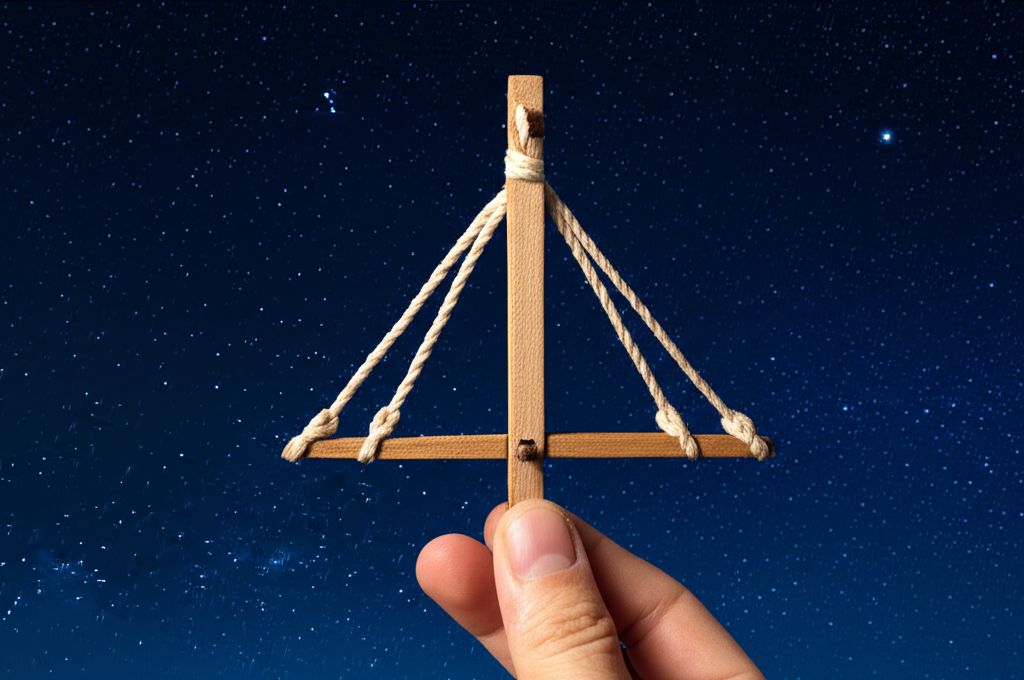
The Kamal emerged as a specialized navigation tool for mariners traversing the Indian Ocean, representing a significant advancement in the practice of maintaining a constant course. Its design, while elementary, was predicated on a sophisticated understanding of celestial positioning for the purpose of holding a specific line of latitude.
The device functioned through a direct relationship between the observer, the horizon, and a celestial body, most often Polaris, the North Star. A navigator would hold the end of a knotted string in their teeth and extend a small wooden card away from their face. The card was moved along the string until its bottom edge aligned with the horizon and its top edge touched the target star. This action fixed the angular height of the star, and by keeping it constant, a vessel could sail due east or west along a precise latitudinal line.
The true strategic brilliance of this instrument was its optimization for established trade routes. Mariners tied a series of knots into the string, with each knot calibrated to the known latitude of a specific destination port. By selecting the correct knot for a port in India or Africa, a captain could confidently sail out into the open ocean. Upon reaching the desired latitude, the vessel would simply turn and follow that line until land was sighted. This method provided a highly reliable system for repeated voyages, removing much of the guesswork from transoceanic navigation.