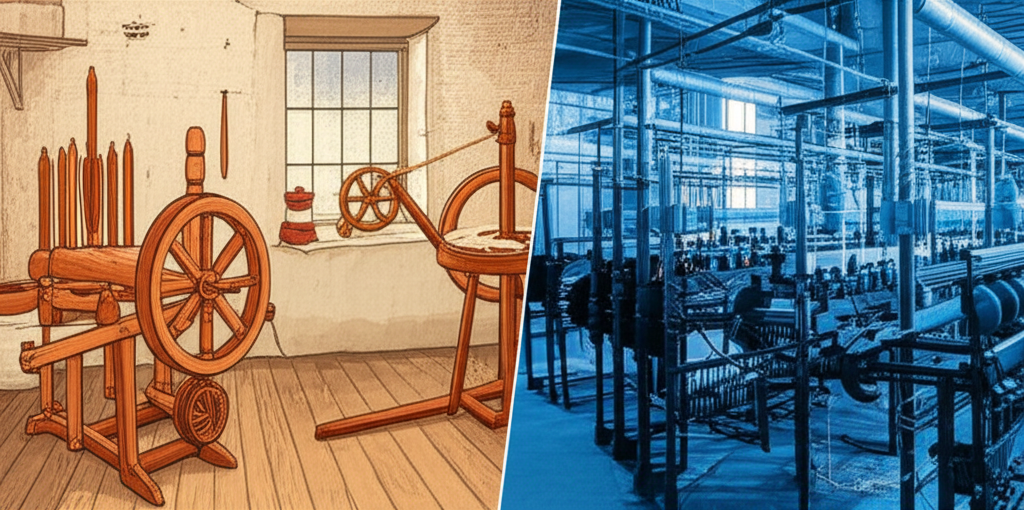
In the mid-eighteenth century, the British textile industry faced a critical stagnation in productivity, primarily driven by the inability of spinners to keep pace with the accelerated demand for yarn created by the flying shuttle. It was within this climate of necessity that James Hargreaves, a weaver from Blackburn, devised the Spinning Jenny around 1764. This invention did not simply refine existing methods; it revolutionized the fundamental mechanics of yarn production by introducing multi-spindle capability to the domestic artisan.
The strategic optimization of the Spinning Jenny lay in its vertical orientation and the utilization of a sliding carriage. Unlike the traditional spinning wheel, which restricted an operator to a single spool, Hargreaves’ design allowed one individual to manipulate eight spindles simultaneously. Later iterations expanded this capacity to eighty or more. This exponential increase in the labor-to-output ratio effectively decoupled production limits from the constraints of manual dexterity, transforming the economics of the cotton trade.
However, this rapid mechanization incited immediate social and economic friction. The local weaving community, recognizing the threat posed to the value of their labor, engaged in acts of industrial sabotage, famously breaking into Hargreaves’ workshop to destroy his machines. Forced to relocate to Nottingham, Hargreaves sought to capitalize on his innovation through the factory system, though his failure to secure an early patent allowed widespread duplication of the device without royalty.
While the yarn produced by the Jenny lacked the tensile strength required for warp threads—a deficiency later rectified by the water frame—its implementation marked the definitive end of the pre-industrial era. By proving that mechanical intervention could multiply human effort rather than merely assist it, Hargreaves laid the foundational logic for the Industrial Revolution.