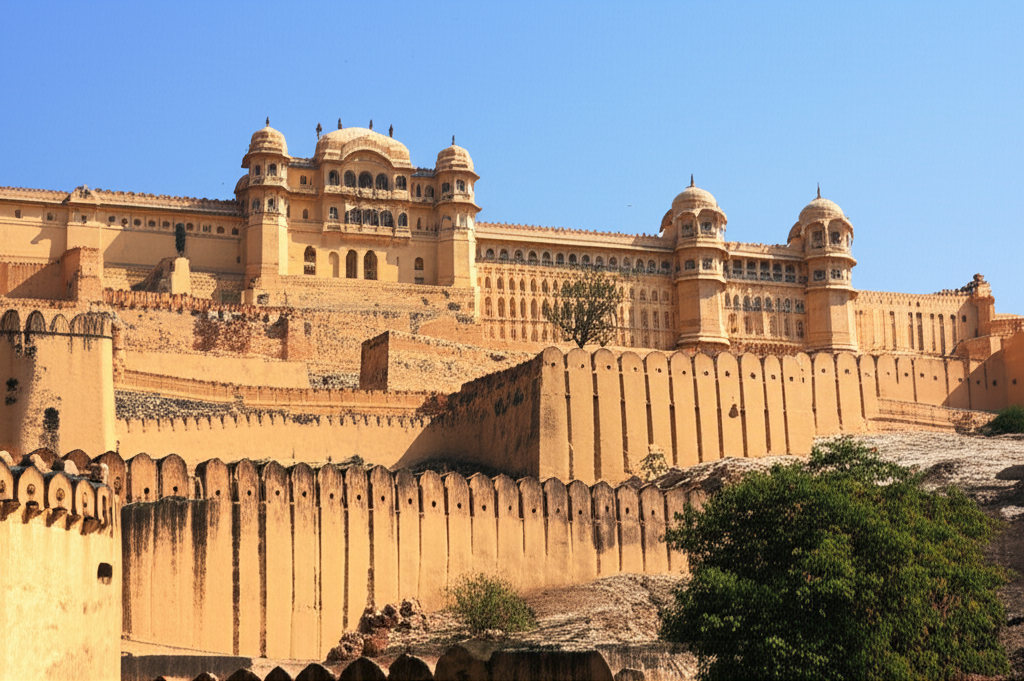
The fortification of the Kachwaha capital commenced in 1592 under the orders of Raja Man Singh I, a distinguished general in Emperor Akbar’s court. Built upon the remnants of earlier indigenous structures, the citadel represented a strategic shift from the vulnerable lowlands to the defensive advantages of the Aravalli range. The initial phases focused on establishing a robust military perimeter, utilizing the rugged terrain to repel potential incursions while asserting regional dominance through imposing masonry.
Architectural evolution continued through the reign of Mirza Raja Jai Singh I, who oversaw significant expansions that softened the structure’s martial austerity. The construction utilized a deliberate synthesis of red sandstone and white marble, reflecting the complex political and cultural alliance between the Rajput royalty and the Mughal Empire. This fusion manifested in the intricate lattice work and symmetric gardens, elements that prioritized courtly refinement alongside defensive utility. The integration of Mughal styles was not merely aesthetic but a calculated display of political alignment and status.
Water management remained a critical aspect of the fort’s engineering optimization. The architects designed an advanced hydraulic system to lift water from Maota Lake to the upper courtyards through a series of reservoirs and pulley mechanisms. This innovation ensured the garrison’s sustainability during prolonged sieges and maintained the climate control systems within the royal chambers. The eventual completion of the complex marked the zenith of Rajput architectural ingenuity before the capital shifted to the plains of Jaipur, preserving the fort as a testament to medieval military strategy and artistic collaboration.