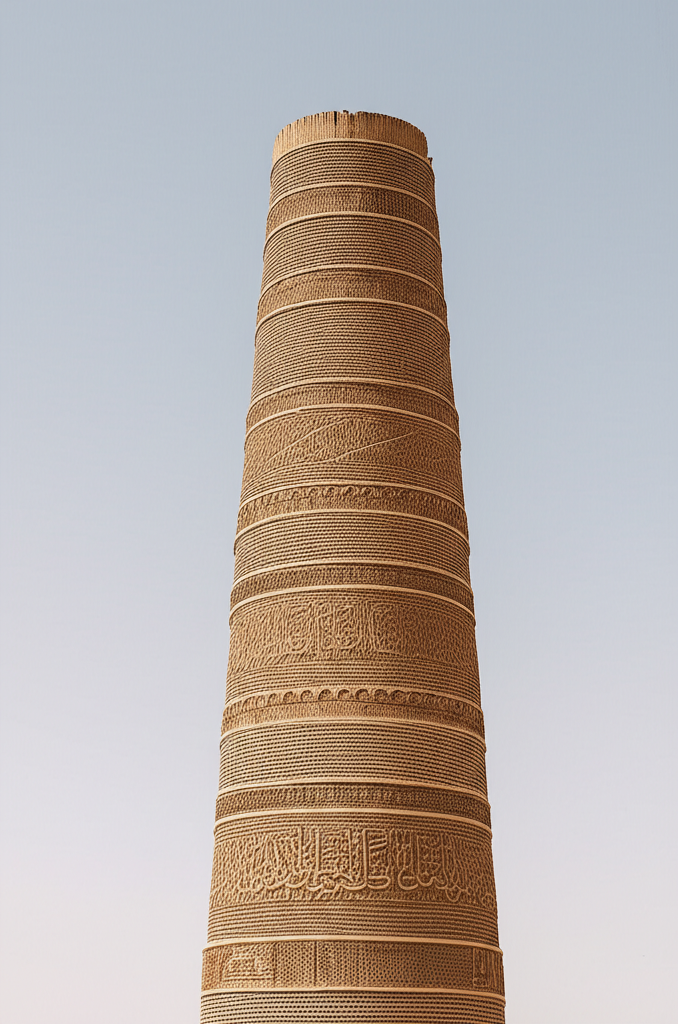
Erected during the zenith of the Ghurid Dynasty in the late 12th century, the Minaret of Jam stood as a singular testament to architectural sophistication within the rugged terrain of central Afghanistan. Situated at the strategic confluence of the Hari Rud and Jam Rud rivers, this soaring structure exemplified the mastery of baked brick construction, a hallmark of the region’s engineering evolution. The architects prioritized verticality and structural resilience, employing a tapering cylindrical design that effectively distributed mass to withstand the seismic instability inherent to the valley.
The structural optimization of the minaret relied on three distinct, superimposed shafts that narrowed as they ascended. This tiered configuration reduced the gravitational load on the foundation while maximizing the visual impact of the tower’s height. Internally, a double-spiral staircase functioned as more than a means of ascent; it served as a rigid structural spine, reinforcing the masonry shell against lateral forces and wind shear. This complexity suggested that the builders possessed advanced knowledge of load dynamics and material stress.
Aesthetically, the facade demonstrated a rigorous application of decorative brickwork. The surface was enveloped in intricate geometric relief patterns and bands of Kufic epigraphy, which documented the lineage of Sultan Ghiyath al-Din Muhammad. The strategic inclusion of turquoise glazed tiles near the summit provided a distinct visual contrast against the monochromatic clay, marking an early adoption of polychromatic techniques that would later dominate Islamic architecture. Through this integration of structural engineering and ornamental precision, the monument affirmed the imperial ambition of the lost capital of Firuzkoh.