
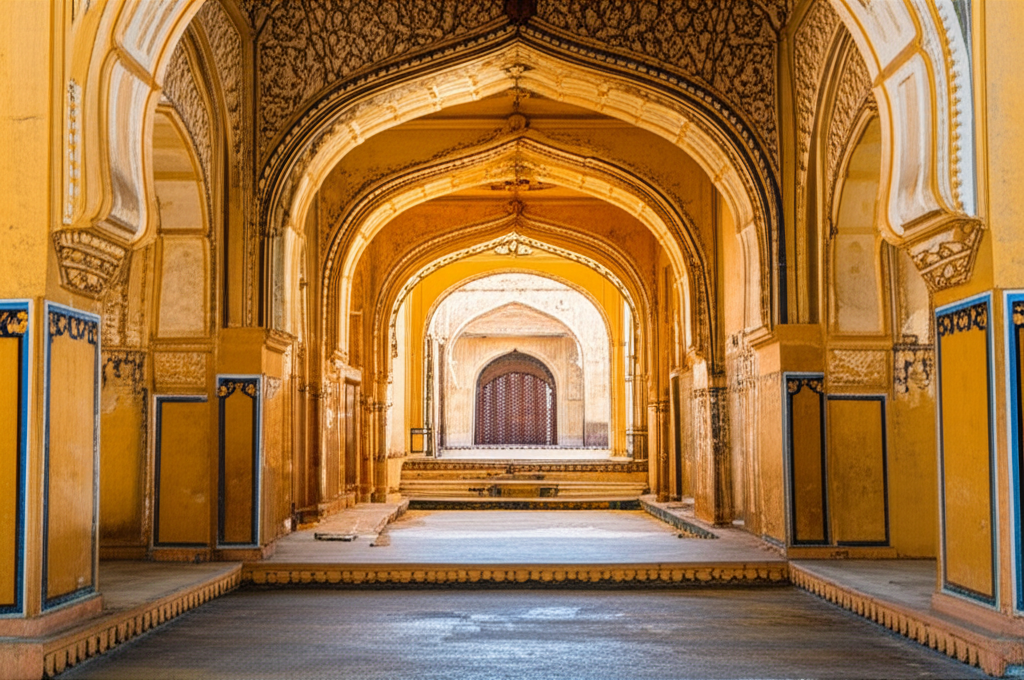
The establishment of Amber Fort in 1592 marked a definitive shift in regional power dynamics under the stewardship of Raja Man Singh I. While the site had previously served as a settlement for the Meenas, the Kachwaha dynasty repurposed the Cheel ka Teela (Hill of Eagles) to establish a stronghold that balanced military impregnability with administrative capacity. The location offered significant strategic advantages; positioned high above Maota Lake, the fortification utilized the rugged terrain as a natural defense while securing a permanent water supply for the garrison.
The construction methodology reflected the complex geopolitical alliances of the era. Utilizing robust red sandstone and white marble, the artisans executed a design that symbolized the synthesis of indigenous Rajput traditions and the architectural symmetry favored by the Mughal Empire. This fusion served a dual purpose: it reinforced the cultural identity of the Kachwahas while acknowledging their diplomatic integration with the Mughal court. The structural layout prioritized security through formidable ramparts and fortified gates, yet simultaneously accommodated the need for courtly refinement.
Expansion continued under successive rulers, most notably Mirza Raja Jai Singh I, who optimized the internal spaces for governance and luxury. The evolution of the complex saw the integration of key architectural elements:
The Diwan-i-Am was developed to centralize public audiences and administrative decrees.
The Sheesh Mahal demonstrated advanced engineering in light reflection and climate control.
By the time the capital eventually shifted to the plains of Jaipur in 1727, Amber had cemented its status as a masterpiece of medieval engineering. It stood not merely as a residence, but as a physical manifestation of military foresight and diplomatic architecture.


