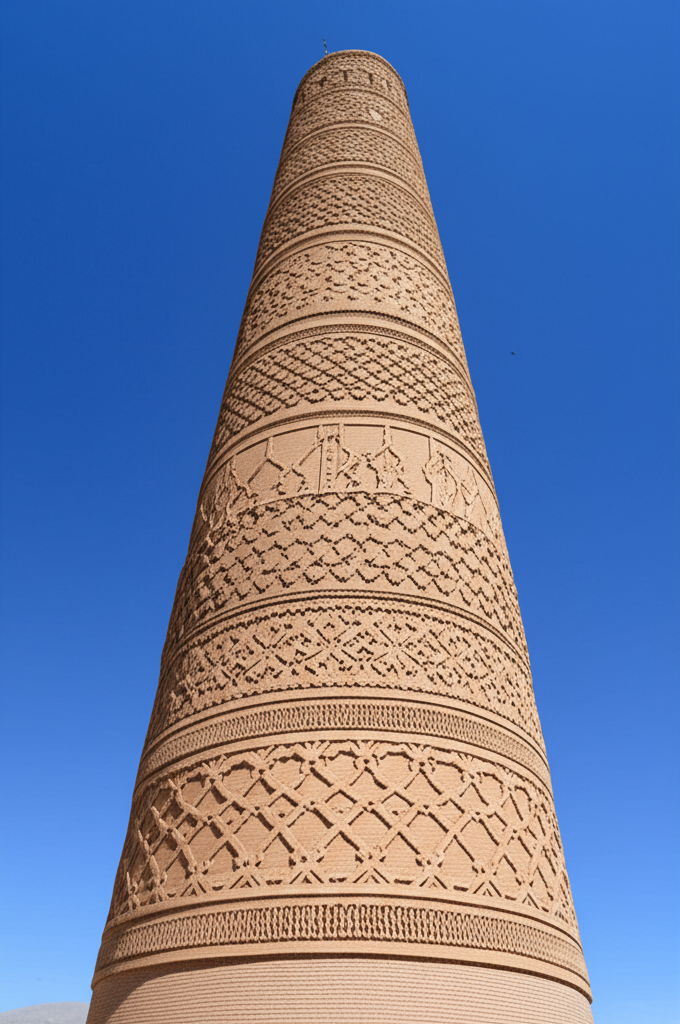
Erected during the zenith of the Ghurid Empire in the late 12th century, the Minaret of Jam stood as a testament to the sophisticated engineering capabilities of the era. Located in a rugged valley in present-day western Afghanistan, the structure was constructed entirely of baked brick, a choice that allowed for intricate detailing despite the harsh environmental conditions. The builders prioritized verticality, creating a tapering cylindrical shaft that rose abruptly from the narrow river canyon, symbolizing both political dominance and religious devotion.
The exterior surface displayed a mastery of decorative brickwork and stucco. The facade was divided into distinct segments, each adorned with geometric patterns and interlaced bands of Kufic calligraphy. These inscriptions, carved deeply into the clay, served not merely as ornamentation but as structural texturing that played with light and shadow. Notably, the inclusion of turquoise glazed tiles—among the earliest examples in the region—highlighted specific verses, marking a strategic evolution in aesthetic techniques that would later dominate Timurid architecture.
Internally, the architects implemented a complex double-spiral staircase, a design feature that maximized structural stability within the slender shaft. This ingeniously engineered core provided rigidity against seismic activity common to the region. The interplay between the massive octagonal base and the refined, tapering upper sections demonstrated an acute understanding of load distribution, ensuring the monument’s survival long after the surrounding city of Firuzkoh fell to ruin.