
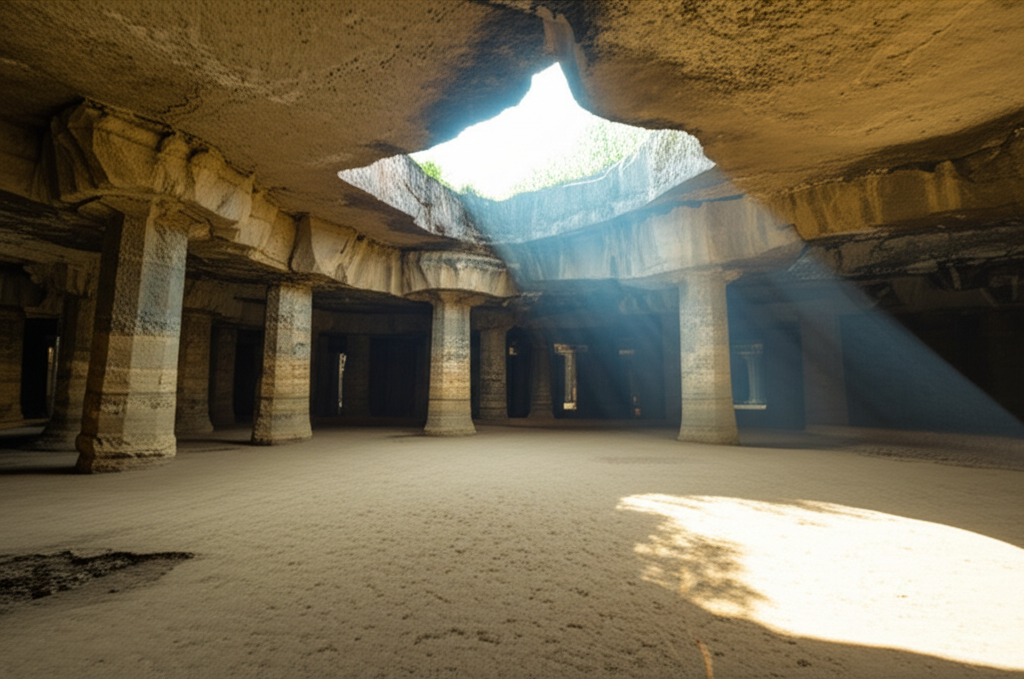
In June 1992, the drainage of deep ponds beneath Phoenix Hill in Zhejiang Province revealed a subterranean complex that defied contemporary understanding of ancient engineering. Known as the Longyou Caves, these twenty-four massive sandstone grottoes were carved with exacting precision, necessitating the calculated removal of nearly one million cubic meters of rock. The complete absence of historical documentation regarding their construction presented a significant anomaly in Chinese historiography, forcing scholars to rely solely on the physical evidence to decipher the site’s origins.
The structural strategy employed by the ancient builders demonstrated a sophisticated grasp of geology and load distribution. To maintain integrity within the cavernous halls, the architects utilized a series of fish-tail pillars, which were evenly spaced to support the immense weight of the ceiling. Furthermore, the walls were finished with uniform chisel marks—parallel lines etched at a consistent sixty-degree angle. This detailing suggested an optimized labor system, indicating that thousands of workers utilized specialized tools in a coordinated effort rather than random digging. This method ensured that, despite the sheer magnitude of the excavation, the internal environment remained stable and preserved for over two millennia.
The ultimate purpose of this complex remains a subject of rigorous debate among archaeologists and historians. Theories ranging from imperial mausoleums to covert military stations were proposed, yet the lack of archaeological debris, such as tools or the displaced stone, complicated these hypotheses. The Longyou Caves stand as a testament to a forgotten era of technological prowess, challenging modern perceptions of ancient industrial capabilities and resource management.


