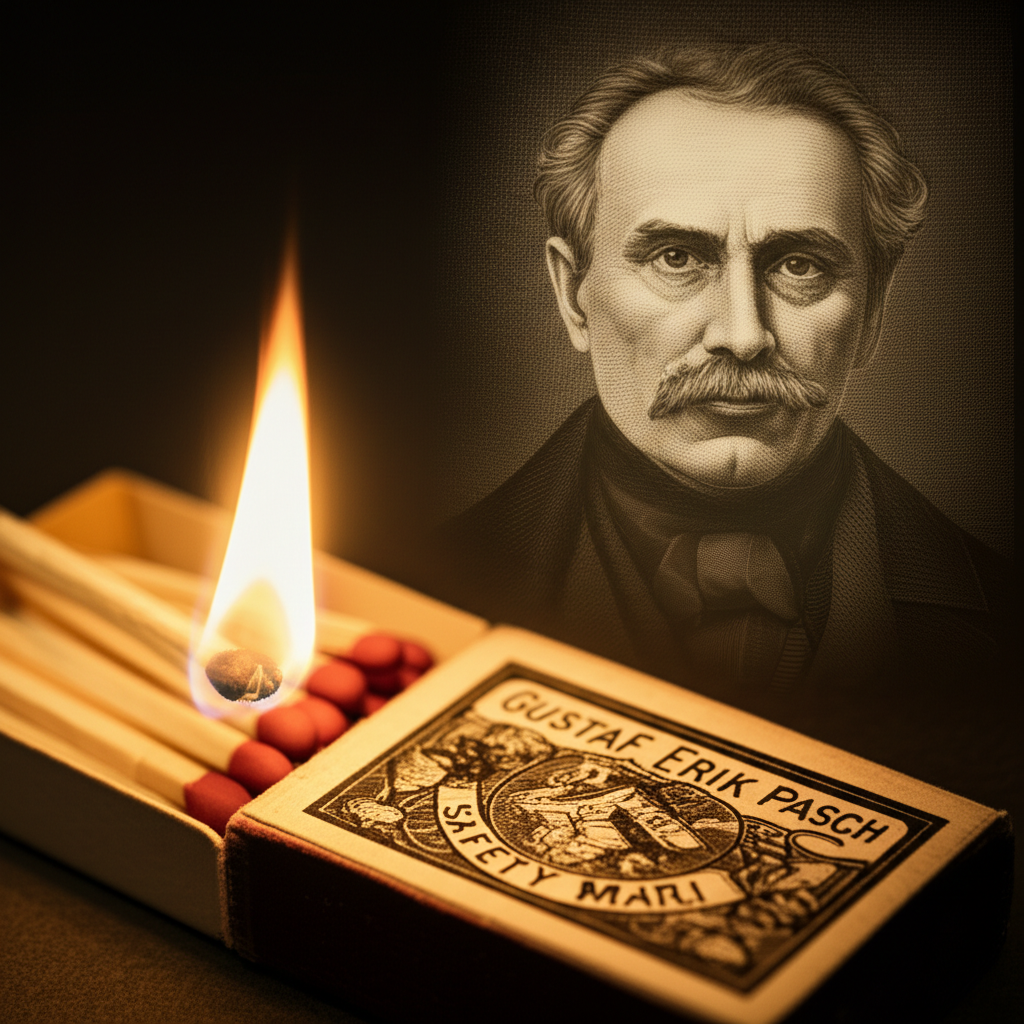
In the mid-19th century, the landscape of domestic and industrial combustion was fraught with peril. Early friction matches, commonly known as lucifers, relied upon White Phosphorus, a substance notorious for its toxicity and chemical instability. It was within this climate of volatility that the Swedish chemist Gustaf Erik Pasch devised a critical optimization to the mechanics of ignition. His 1844 patent marked a definitive departure from the hazardous designs that plagued the era, prioritizing safety through chemical segregation.
Pasch’s strategic innovation lay in the separation of the reactive components, a method that fundamentally altered the ignition process. Rather than incorporating the combustible phosphorus directly into the match head—which made early versions susceptible to accidental ignition through rough handling—Pasch relocated a non-toxic variant, Red Phosphorus, to a specially prepared striking surface.
The match head itself was reformulated with Potassium Chlorate and antimony sulfide. This segregation ensured that ignition could only occur through deliberate friction against the designated strip, effectively eliminating the risk of spontaneous combustion inside pockets or storage containers.
Segregation of Reactants: By isolating the phosphorus from the oxidizer, the chemical reaction remained dormant until specifically triggered.
Toxicity Reduction: The substitution of red phosphorus removed the severe health risks associated with “phossy jaw,” a condition common among match factory workers.
Although the immediate commercialization of Pasch’s invention was hindered by the high cost and impurity of red phosphorus at the time, his theoretical framework established the blueprint for the modern Safety Match. His work shifted the paradigm of fire-making from a dangerous necessity to a controlled chemical reaction, laying the foundational strategy for the subsequent dominance of the Swedish match industry.