
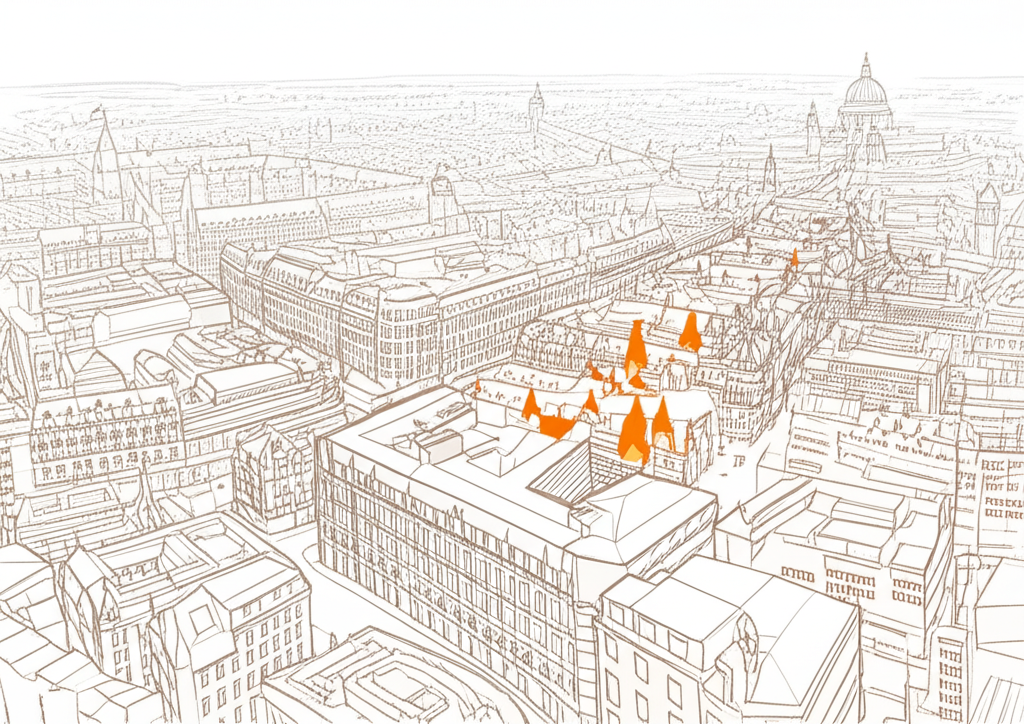
The cataclysm of the Great Fire of London in 1666 presented an unprecedented, if tragic, opportunity for urban reformation. In the immediate aftermath, visionary proposals were submitted to King Charles II, advocating for a complete redesign of the city’s medieval fabric. The most celebrated of these was a plan by Sir Christopher Wren, which envisioned a rational grid of wide boulevards and grand piazzas, emulating the Baroque elegance of continental capitals. This, along with other ambitious schemes, sought to impose order and grandeur upon the smoldering ruins.
However, the exigencies of commerce and the intractable complexities of pre-existing property rights rendered such grand schemes untenable. The urgent need to restore trade and housing took precedence over aesthetic idealism. Consequently, the fundamental street plan of London was largely retained, following the ancient lines of property ownership that had defined the city for centuries. The true revolution in city planning was therefore not topographical but regulatory.
The lasting legacy of the fire was codified in legislation, most notably the Rebuilding of London Act 1666. This series of parliamentary acts mandated stringent building controls that fundamentally altered the city’s character. Timber-framed construction was outlawed in favor of brick and stone to mitigate fire risk, while building heights and designs were standardized according to the prominence of the street they occupied. This pragmatic, safety-oriented approach, rather than a sweeping redesign, established a new paradigm for municipal oversight in urban development, creating a more resilient, if less geometrically perfect, metropolis.


