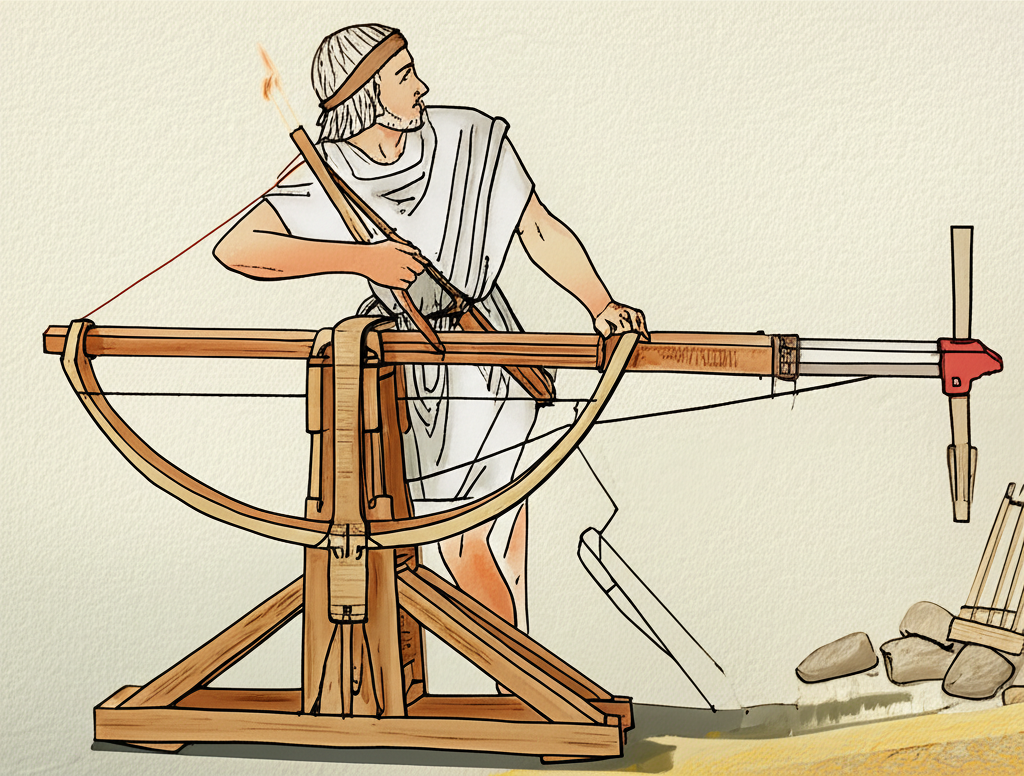
The emergence of the Gastraphetes constituted a significant evolution in the ballistic capabilities of Ancient Greek military forces. Unlike traditional composite bows that relied solely on the archer’s arm strength, this device utilized a mechanical slider and a concave stock. By leaning their body weight against the rear rest, the operator could span a bow of considerably higher draw weight. This optimization allowed for a release of kinetic energy that far surpassed contemporary handheld weaponry, granting the user the ability to penetrate reinforced armor and shields at extended distances.
In the context of siege warfare, the tactical application of the belly bow proved instrumental in breaking defensive stalemates. Commanders deployed these weapons to establish suppression fire against enemy battlements. The extended range allowed attackers to target and neutralize defenders on the walls without exposing themselves to the shorter range of conventional return fire. This asymmetrical advantage created safe corridors for the advancement of sappers and the positioning of siege towers.
Furthermore, the Gastraphetes represented a crucial transitional phase in military engineering. It bridged the gap between infantry archery and the later development of torsion artillery, such as the ballista. The shift toward mechanized tension demonstrated a strategic prioritization of range and power over mobility, fundamentally altering how fortified positions were assaulted and defended during the classical period.