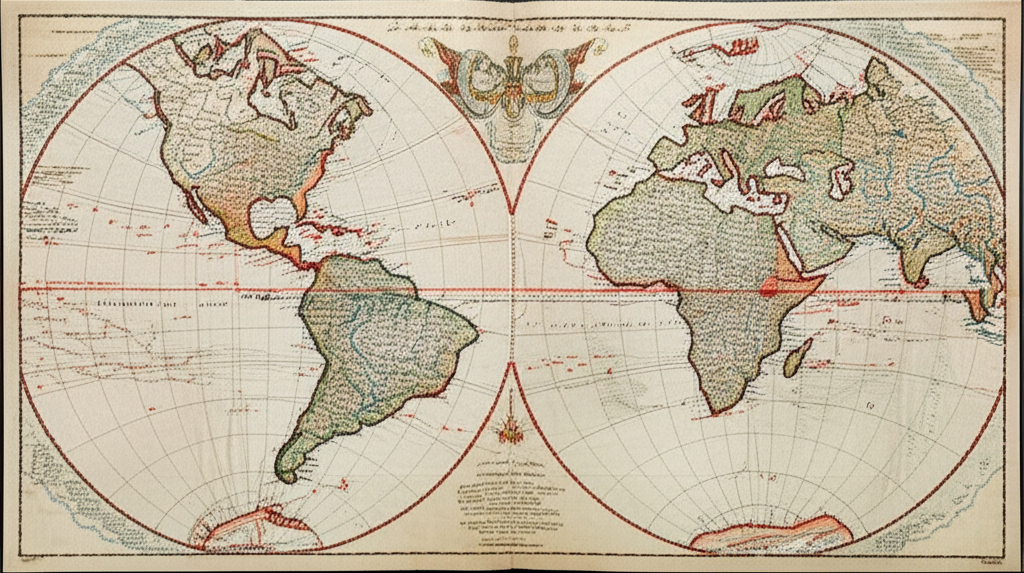
Gerardus Mercator’s 1569 world map, titled Nova et Aucta Orbis Terrae Descriptio ad Usum Navigantium Emendate Accommodata, represented a pivotal moment in cartographic history. It was not merely a new depiction of the world but a sophisticated tool engineered to solve the paramount navigational challenge of the era.
The map’s primary innovation was the Mercator projection, a mathematical construct designed to aid mariners. By projecting the spherical Earth onto a cylinder, Mercator ensured that any straight line drawn on his map was a line of constant compass bearing, known as a rhumb line. This strategic decision transformed complex navigational plotting into a simple exercise of drawing a straight course from origin to destination, a profound optimization for long-distance sea voyages.
This navigational utility, however, came at the cost of severe geographical distortion. To preserve the straight rhumb lines, the projection progressively inflates the size of landmasses as they approach the poles. Greenland, for instance, appears larger than Africa, an inaccuracy Mercator accepted as a necessary compromise. The map was never intended as a faithful representation of relative area but as a functional instrument for maritime navigation.
Its design prioritized practical application over terrestrial accuracy, fundamentally shaping the course of global exploration and trade. By providing a reliable and unprecedented method for charting a course across the vast oceans, the Mercator map became the standard for nautical charts for centuries that followed.