
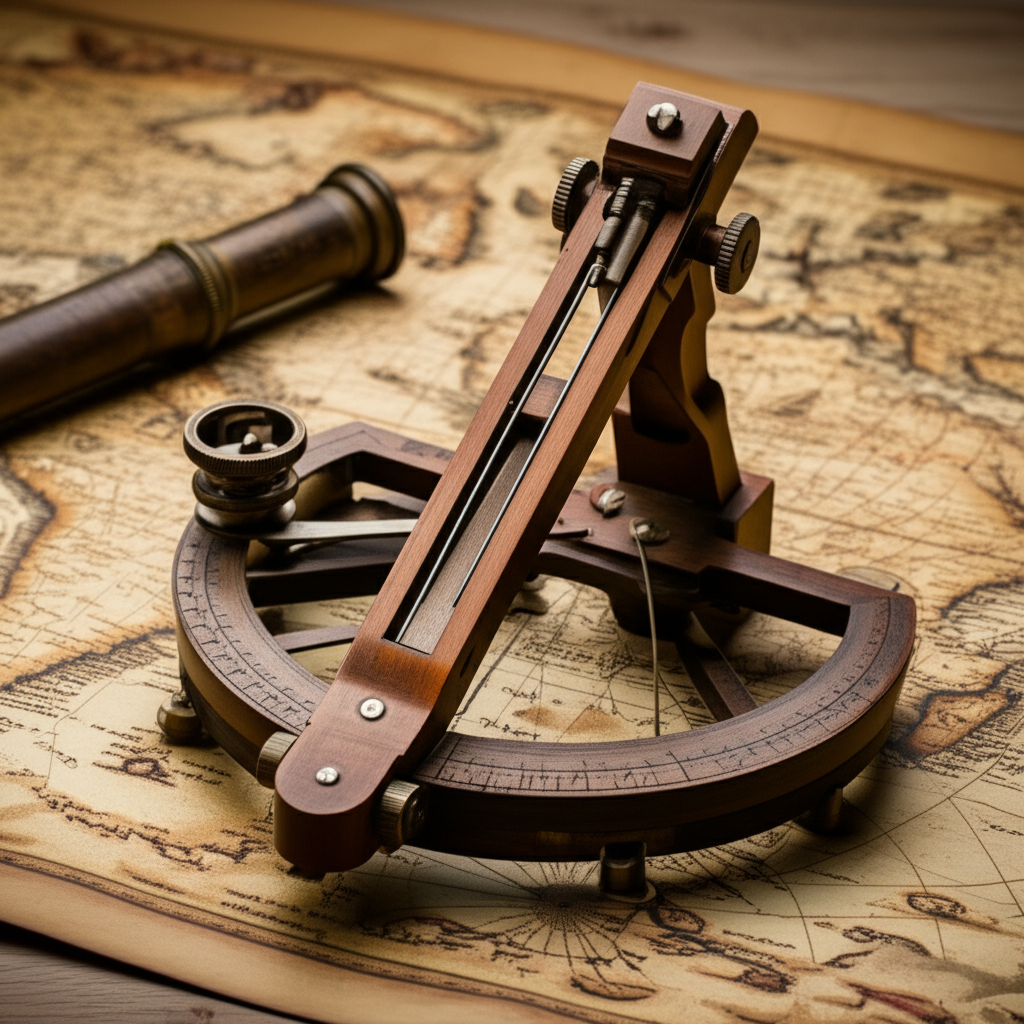
The emergence of the Davis Quadrant in the late 16th century marked a significant evolution in maritime navigation. Invented by English navigator John Davis around 1594, this instrument, also known as the backstaff, was engineered to overcome the critical flaws of its predecessors, most notably the cross-staff. The primary strategic advantage of the Davis Quadrant was its method of observation. Navigators no longer needed to look directly into the sun to measure its altitude, an act that was both dangerous and prone to inaccuracy due to the intense glare.
This new design allowed the observer to stand with their back to the sun, aligning the shadow cast by an upper vane with the horizon, viewed simultaneously through a slit in a lower vane. This “back-observation” technique dramatically improved the precision of celestial readings. The instrument’s dual-arc construction further refined measurements, enabling mariners to determine their latitude with a greater degree of confidence than was previously attainable. This optimization was not merely an incremental improvement; it was a fundamental shift that enhanced the safety and efficiency of long-distance oceanic voyages.
For over a century, the Davis Quadrant remained the principal instrument for latitude determination at sea among English and American mariners. Its dominance waned only with the invention of the octant in the 1730s, which offered superior accuracy and ease of use. Nevertheless, the quadrant stands as a pivotal development in the history of navigation, representing a crucial bridge between the rudimentary tools of the medieval period and the highly sophisticated instruments that would define the Age of Sail.


