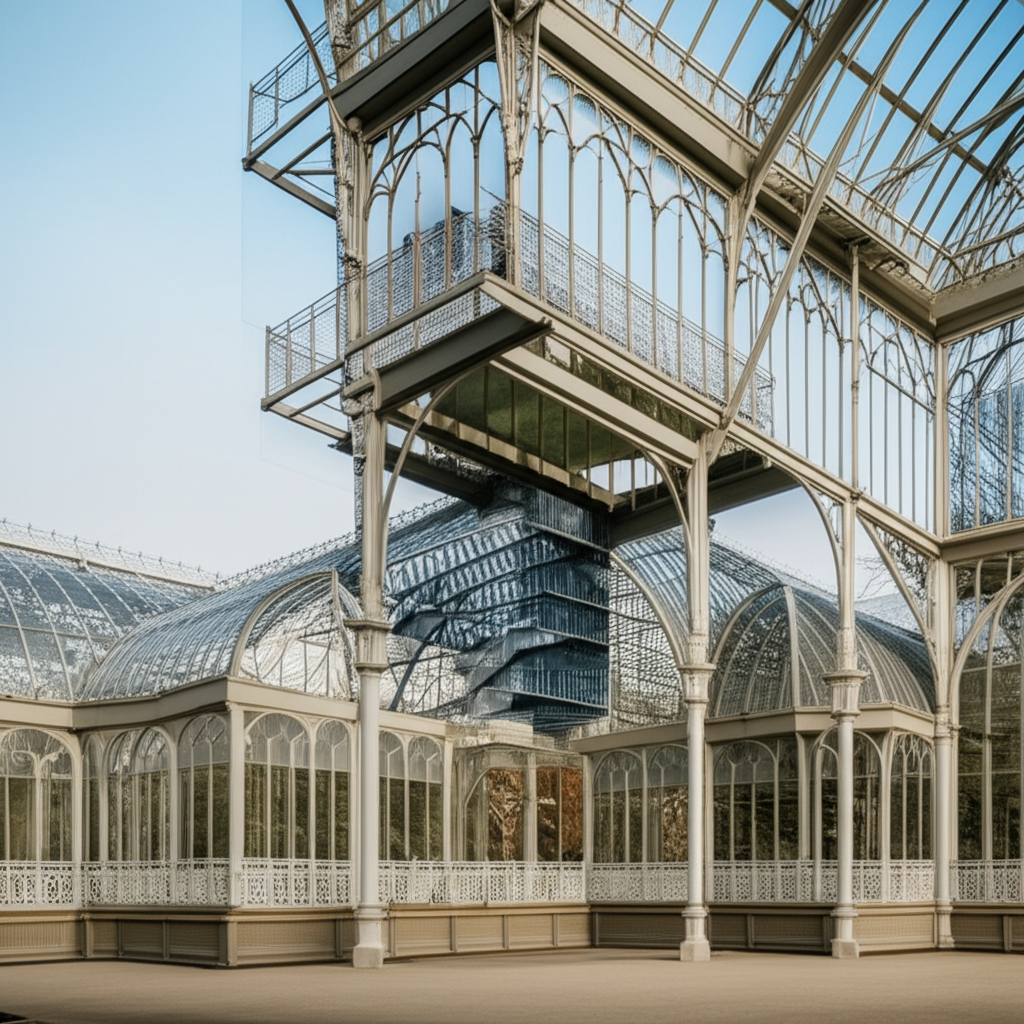
In 1851, the industrial world converged upon Hyde Park, not to witness a triumph of stone, but a revolution in iron and light. The Crystal Palace, designed by Joseph Paxton, represented a decisive departure from the heavy, wet-construction methods that had defined monumental architecture for millennia. Rather than relying on the slow accretion of masonry, Paxton approached the commission with the logic of a horticulturalist and the efficiency of a manufacturer, prioritizing speed and logistical optimization above all else.
The genius of the design lay in its rigorous adherence to modular architecture. Paxton optimized the entire structure around the maximum dimensions of a single sheet of hand-blown glass—49 inches. This standardized unit dictated the spacing of every column, girder, and sash bar, creating a rhythmic grid that facilitated rapid mass production. By shifting the primary work from the building site to the foundry, the project successfully bypassed traditional constraints of weather and skilled labor availability.
The execution demonstrated an unprecedented mastery of prefabrication. Cast-iron components were manufactured in Birmingham and transported to London, where they were assembled with mechanical precision. The structure functioned as a colossal kit of parts, featuring a sophisticated ridge-and-furrow roofing system that utilized the structural framework itself to channel rainwater through hollow columns, integrating drainage directly into the supports.
This synthesis of engineering and logistics allowed the vast edifice to rise in a matter of months, a feat previously deemed impossible. It stood not merely as an exhibition hall, but as a harbinger of the industrial assembly line applied to the built environment, fundamentally altering the trajectory of architectural history.