
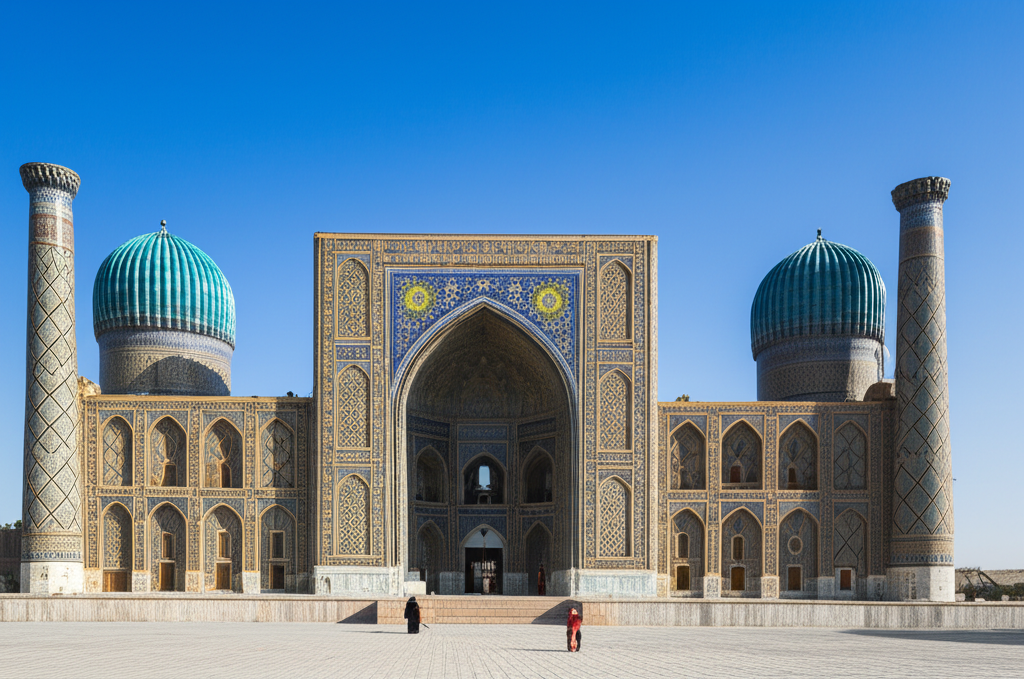
Following his triumphant return from the Indian campaign in 1399, the conqueror Timur decreed the creation of a sanctuary that would surpass all others in the Islamic world. The construction of the Bibi-Khanym Mosque in Samarkand was not merely an act of religious piety, but a calculated geopolitical statement designed to cement the prestige of the Timurid Empire. With resources plundered from Delhi, Timur mobilized a vast workforce of artisans, stonecutters, and architects drawn from across his conquered territories to execute this grand vision.
The project was defined by an unprecedented rapidity of execution. Timur, impatient with standard building timelines, personally oversaw the operations, frequently intervening to accelerate the pace. This strategic prioritization of speed over stability utilized ninety-five elephants to haul marble and stone, optimizing the logistical flow of heavy materials. However, this haste proved to be the structure’s greatest liability. The engineering methods employed struggled to support the sheer scale of the design; the structural integrity of the masonry could not fully sustain the weight of the colossal dome, leading to early signs of fracturing even before the complex was fully inaugurated.
Architecturally, the mosque featured a classic four-iwan layout centered around a vast courtyard, culminating in a main sanctuary crowned by a massive double-shell azure dome. While the decorative glazing and geometric precision demonstrated the height of Central Asian artistry, the static load of the building overwhelmed its foundations. Ultimately, the mosque stood as a testament to imperial ambition, illustrating the historical tension between architectural innovation and the immutable laws of physics.


