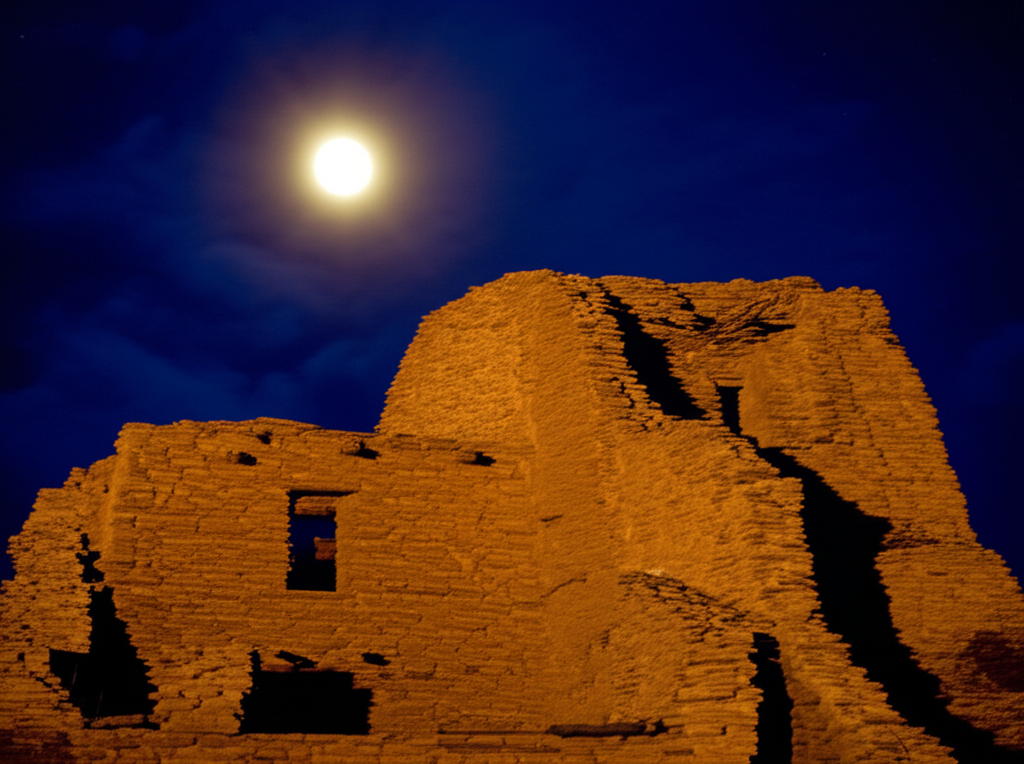
Situated on a high, narrow ridge, the Chimney Rock Great House represented a singular feat of Chacoan engineering. The builders navigated steep, precipitous terrain to transport massive timbers and thousands of sandstone blocks, adhering strictly to the rigid architectural standards of the distant Chacoan core. The isolated location was not selected for ease of habitation or resource proximity, but rather for its unique geometric relationship with the horizon and the surrounding geological features.
The site’s primary strategic value lay in its alignment with the Major Lunar Standstill. This astronomical event, occurring every 18.6 years, featured the moon rising precisely between the twin stone pillars known as Chimney Rock and Companion Rock when viewed from the Great House.
Dendrochronological analysis confirms that major construction phases in 1076 and 1093 CE synchronized perfectly with these lunar events.
The layout was deliberately optimized to frame this celestial phenomenon, turning the building into a monumental viewing platform.
By integrating architecture with the natural landscape, the site functioned as a cosmic observatory. The structure allowed elites to predict and frame the lunar cycle, thereby solidifying their ritual authority through the control of time. This unified design demonstrated a profound command over both physical construction and temporal observation, marking the site as a critical outpost for ceremonial engagement rather than a mere settlement.