
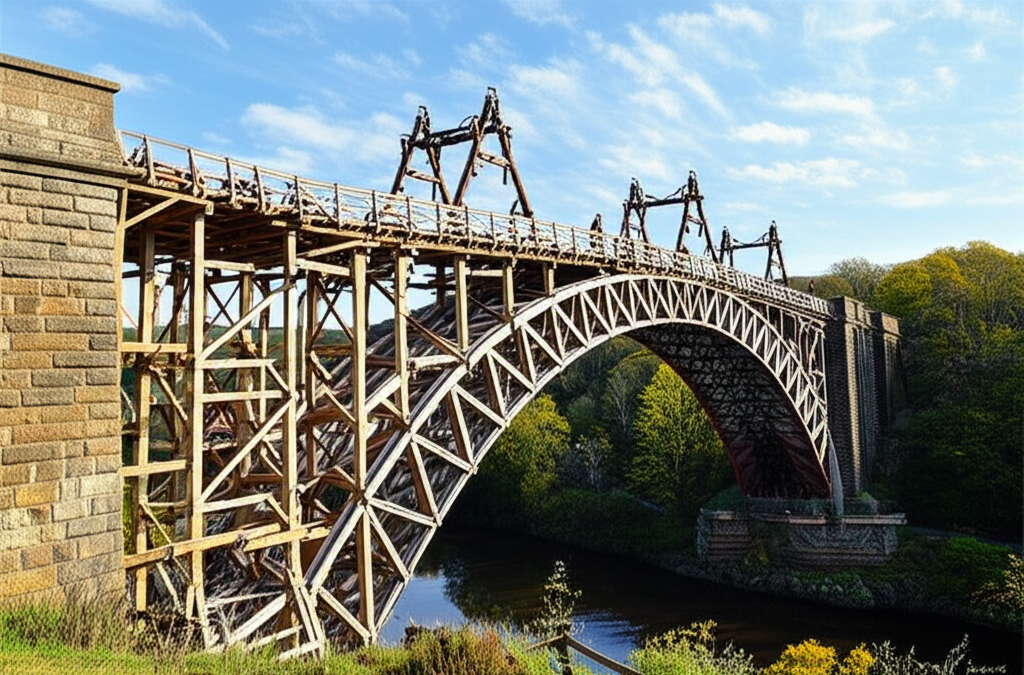
The erection of the Iron Bridge at Coalbrookdale, commencing in 1779, represented a monumental leap in civil engineering. Conceived by architect Thomas Farnolls Pritchard and executed by the ironmaster Abraham Darby III, the project was not merely a crossing over the River Severn but a definitive statement of Britain’s industrial prowess. The strategic decision to construct the bridge entirely from cast iron was a radical departure from the established masonry and timber traditions of the era.
The construction methodology ingeniously adapted principles from carpentry. Large, semi-circular ribs were individually cast at the nearby Bedlam Furnaces. Each component was designed with joinery features, such as dovetails and mortise-and-tenon joints, allowing the massive pieces to be fitted together with remarkable precision. This modular approach was a strategic necessity, as it simplified both the casting process and the complex on-site assembly. The builders relied on their deep understanding of joinery, applying it to a material that had never before been used on such a scale for a load-bearing structure.
Transporting the immense iron sections, some weighing over five tons, from the furnace to the riverbank required considerable logistical planning. A specialized wooden derrick, mounted on boats, was employed to hoist the heavy ribs into their final positions. The segments were then skillfully bolted and wedged together, forming the elegant arch that has defined the structure. The successful completion of the Iron Bridge in 1781 served as a powerful demonstration of the structural potential of cast iron, directly influencing the course of bridge building and architectural design for the next century.

