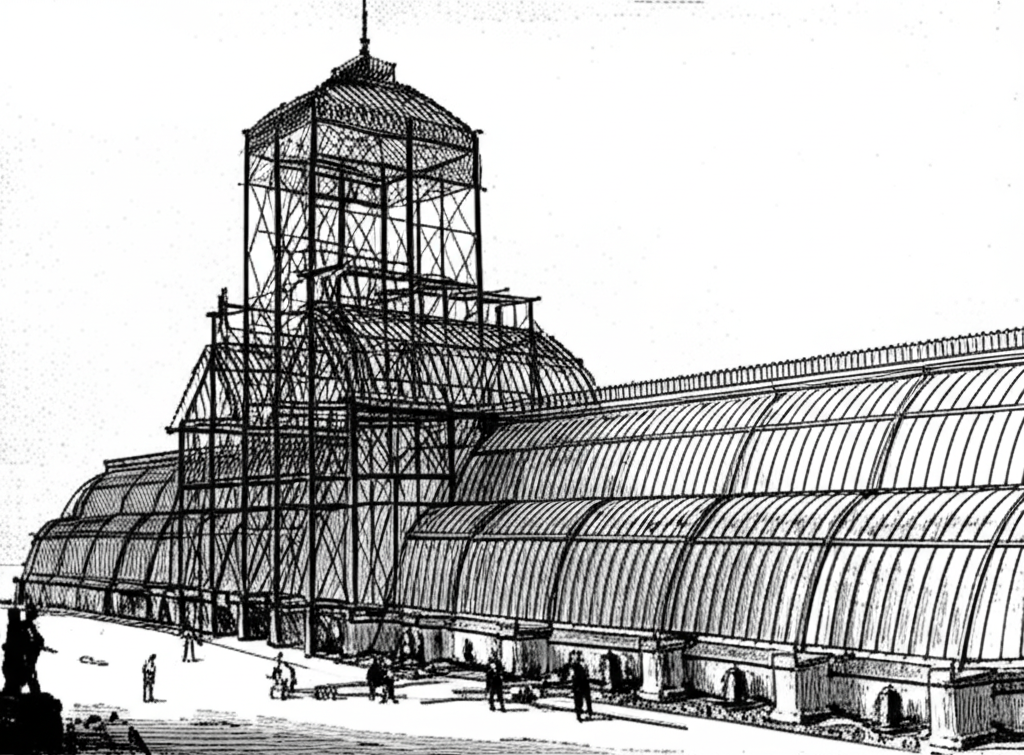
The construction of The Crystal Palace for the Great Exhibition of 1851 was a monumental undertaking, defined not by traditional masonry but by industrial ingenuity and strategic optimization. The Royal Commission, faced with an impossibly short timeline, found conventional architectural proposals inadequate. The solution emerged from an unlikely source: Joseph Paxton, a head gardener whose expertise lay in designing large-scale glasshouses.
Paxton’s design was a masterclass in efficiency, centered on the principles of modular construction and prefabrication. His plan abandoned the slow, labor-intensive methods of brick and stone in favor of a standardized system of cast iron columns, girders, and nearly 300,000 panes of newly developed cast plate glass. These components were mass-produced in factories across the Midlands and transported to Hyde Park for assembly, transforming the construction site into a place of rapid, systematic erection rather than fabrication.
This approach represented a profound strategic shift. The building’s design was, in effect, a detailed instruction manual for its own assembly. Specialized machinery, such as horse-drawn glazing wagons, was developed to install the glass panes at an unprecedented rate. The result was that a structure covering nineteen acres was erected in a mere nine months, a testament to a new industrial logic that prioritized systematic planning and manufacturable components over bespoke craftsmanship.