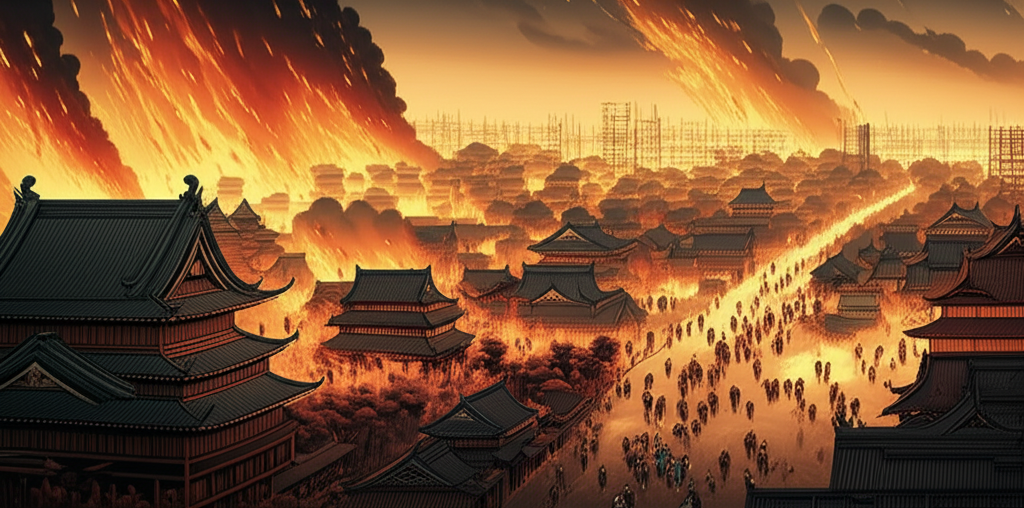
The Great Fire of Meireki in 1657 served as a pivotal inflection point in the urban history of Japan, forcing the Tokugawa Shogunate to abandon piecemeal expansion in favor of comprehensive city planning. Before the disaster, Edo was a dense, organic labyrinth of timber and thatch, vulnerable to the slightest spark. The aftermath demanded a radical shift in spatial organization, prioritizing disaster mitigation over the rigid confines of military fortification.
Central to this reconstruction was the strategic implementation of de-densification. The shogunate mandated the relocation of major temples and shrines from the city center to the periphery, establishing the sprawling religious districts in areas like Asakusa and Yanaka. This migration not only reduced the combustible mass within the urban core but also dispersed the population, spurring the economic development of the suburbs. Furthermore, the administration introduced wide avenues and hirokoji—deliberate firebreaks designed as open plazas to prevent flames from vaulting across neighborhoods.
Architectural standards underwent a similarly rigorous overhaul. To curb the intensity of future infernos, the government incentivized the adoption of fire-resistant materials. The transition from flammable wood shingles to heavy kawara (roof tiles) and the widespread application of earthen plaster significantly hardened the city’s infrastructure. Notably, the Edo Castle keep, destroyed in the blaze, was left unreconstructed to conserve resources for urban recovery, signaling a decisive prioritization of civic stability over symbolic dominance. Through these calculated interventions, the catastrophe was leveraged to transform Edo from a medieval fortress town into a resilient, organized metropolis.