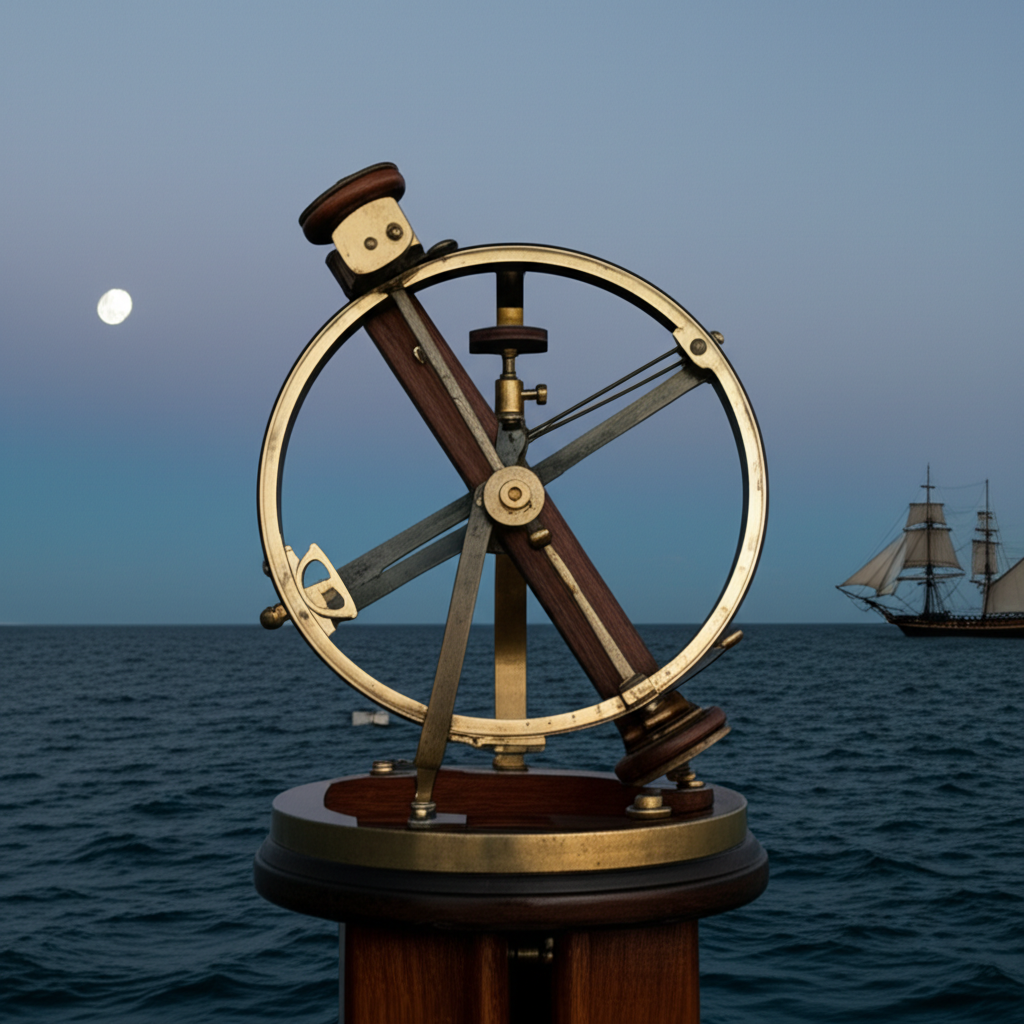
During the late medieval period, mariners faced the peril of temporal blindness once the sun dipped below the horizon. While the astrolabe served well under the solar gaze, the navigational necessities of the Age of Discovery demanded a robust solution for the night watch. The Nocturnal, also known as the nocturlabe, emerged as a critical response to this strategic deficit, allowing navigators to determine local time relative to the apparent rotation of the celestial sphere.
Unlike the complex calculations required by other stellar instruments, the Nocturnal offered a streamlined optimization for rough seas. Constructed typically of wood or brass, the device functioned on a principle of analog computation. The pilot aligned the center hole with Polaris, the North Star, while the rotatable arm was set parallel to the Guards—the two stars, Kochab and Pherkad, forming the outer edge of the Little Dipper. By correlating these positions with the date set on the outer disc, the instrument revealed the time with sufficient accuracy for maintaining the ship’s log and calculating tides at distant ports.
This mechanical innovation represented a significant shift in maritime strategy. It liberated sailors from the reliance on estimated sandglass measurements, which were prone to cumulative error over long voyages. By fixing their temporal position against the eternal clockwork of the heavens, commanders could refine their dead reckoning calculations. This ensured that the expansion of maritime trade routes proceeded with unprecedented, albeit relative, precision during the centuries of oceanic exploration.