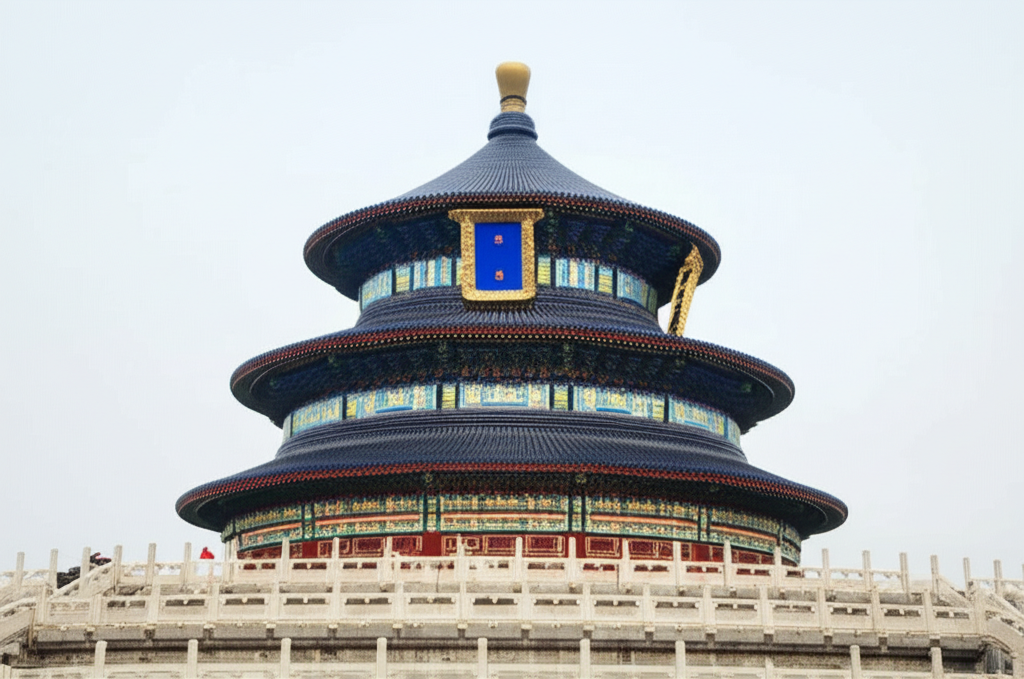
Commissioned during the fifteenth century by the Yongle Emperor, the Temple of Heaven stood not merely as a grand structure, but as a calculated instrument of imperial legitimacy. The Ming dynasty architects prioritized a design that harmonized the earthly realm with the celestial, adhering to strict cosmological principles to secure the dynasty’s mandate.
The layout employed a deliberate geometric strategy known as Tian Yuan Di Fang—Round Heaven, Square Earth. The northern semi-circle represented the heavens, while the southern square symbolized the earth, creating a physical map of the universe within the capital. The complex was dominated by the Hall of Prayer for Good Harvests, a masterpiece of wooden engineering constructed without a single nail. This structural optimization ensured the building’s resilience against time and elements, while the triple-eaved roof, tiled in deep blue, visually connected the monarch’s pleas directly to the sky.
The religious hierarchy within these walls was absolute and exclusionary. Only the Son of Heaven possessed the spiritual authority to intercede for the nation’s agricultural prosperity. During the Winter Solstice, the Emperor performed solemn rites at the Circular Mound Altar, a processional optimized to reinforce his unique status as the sole bridge between the human and divine.
Commoners were strictly barred from viewing the procession, maintaining a shroud of mystery that strengthened the throne’s authority. This rigid stratification served a dual purpose:
It satisfied the ancient demands of ritual propriety regarding celestial worship.
It solidified the political stability of the empire through performed reverence.
Through this meticulous orchestration of architecture and ritual, the imperial court effectively maintained order, ensuring that the spiritual hierarchy mirrored and supported the political structure of the state.