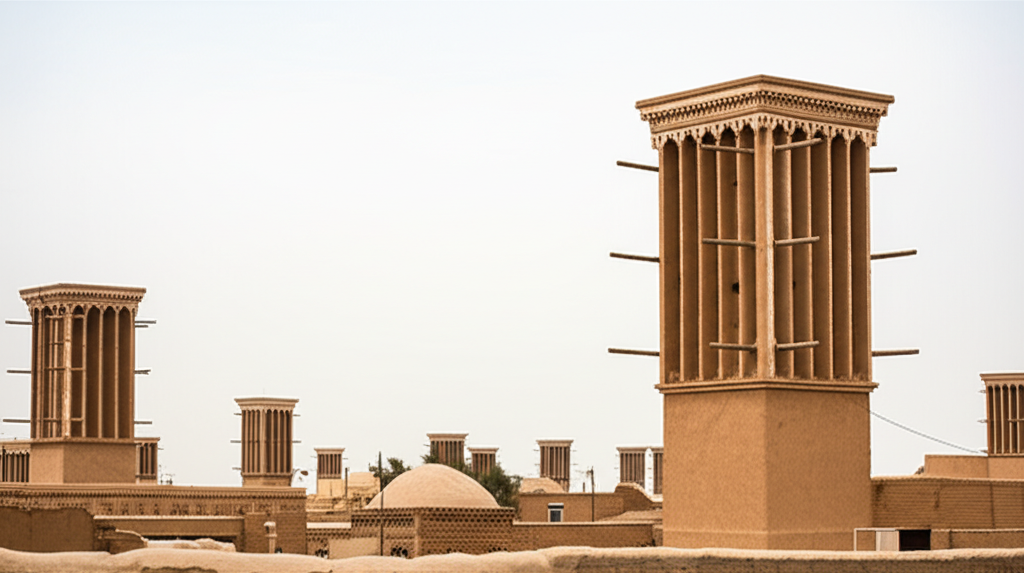
Within the arid expanse of the Persian plateau, the urban fabric of Yazd was defined by the commanding silhouette of the Badgir. These architectural marvels operated not merely as simple ventilation shafts but as sophisticated atmospheric regulators designed to combat the relentless desert heat. Ancient architects optimized these towers to exploit wind pressure differentials, effectively forcing cool air downward while expelling accumulated heat from the interiors. The orientation of the intakes was rigorously calculated, often facing the prevailing Isfahani wind to maximize intake efficiency during the sweltering summer months.
The efficacy of this system was significantly amplified through its strategic integration with the Qanat, an underground aqueduct network. By routing the windcatcher’s airflow over these subterranean water channels, builders achieved a potent form of evaporative cooling. This interaction reduced the ambient temperature of the incoming air before it circulated through the living quarters. Furthermore, the dense adobe walls of the structures provided substantial Thermal Mass, absorbing heat during the day and releasing it slowly at night, which stabilized the internal microclimate against the desert’s extreme diurnal temperature fluctuations.
Even in the absence of external breezes, the badgir maintained functionality through the Chimney Effect. As the interior air warmed, its density decreased, causing it to rise and escape through the leeward openings of the tower. This passive suction drew cooler air from shaded courtyards or basements, ensuring a constant air exchange. This dual capability—acting as both a pressure-driven intake and a temperature-driven exhaust—demonstrated a mastery of fluid dynamics that allowed civilization to flourish in an otherwise inhospitable environment.