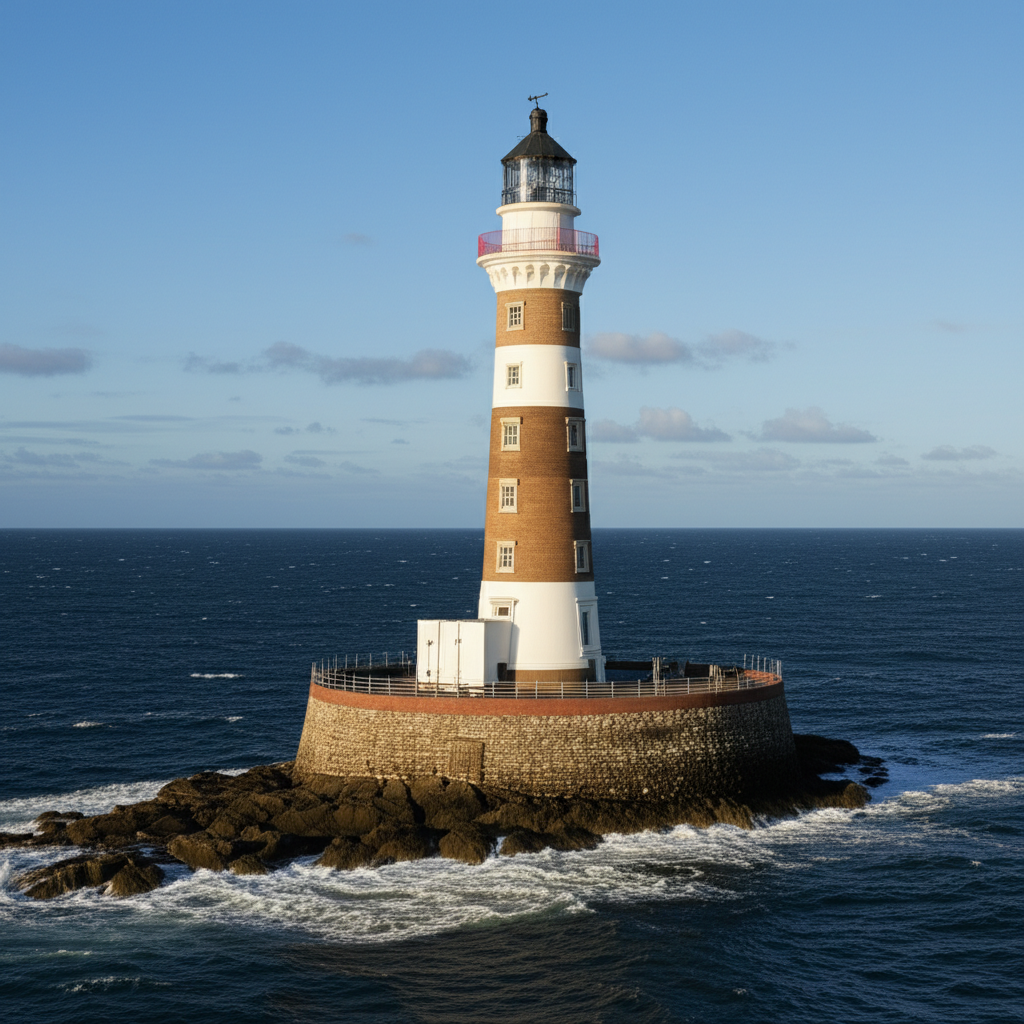
The maritime chronicles of the English Channel are largely defined by the perilous Eddystone Rocks, a reef that long tormented naval navigation south of Plymouth. The strategic imperative to illuminate this hazard prompted a series of architectural endeavors, beginning with Henry Winstanley in the late 17th century. His ornate, octagonal structure, while proving that a beacon could be maintained offshore, suffered from a lack of hydrodynamic consideration. Its destruction during the Great Storm of 1703 underscored the futility of relying on timber and iron against the unbridled Atlantic.
Following the fiery demise of John Rudyard’s subsequent wooden cone in 1755, the narrative of lighthouse construction shifted fundamentally towards masonry and permanence. The commission fell to John Smeaton, a mathematician who approached the project with unprecedented engineering rigor. Smeaton identified that weight and cohesion were paramount. He pioneered the use of hydraulic lime, a material capable of setting underwater, which revolutionized maritime mortar usage.
Crucially, Smeaton abandoned simple stacking in favor of dovetailed granite blocks. This technique ensured that the stones interlocked mechanically, allowing the tower to act as a monolithic mass rather than a collection of parts. Modeled on the shape of an oak tree to dissipate wave energy, Smeaton’s tower stood firm for 120 years, serving as the archetype for all modern offshore lighthouses.
By the late 19th century, it was the reef itself, rather than Smeaton’s masonry, that began to fail. James Douglass oversaw the construction of the current tower in 1882, utilizing larger stones and a dedicated cofferdam to secure the foundation on a separate portion of the rock. While Douglass improved upon the scale, the underlying methodology remained indebted to Smeaton’s objective analysis of stone and sea.