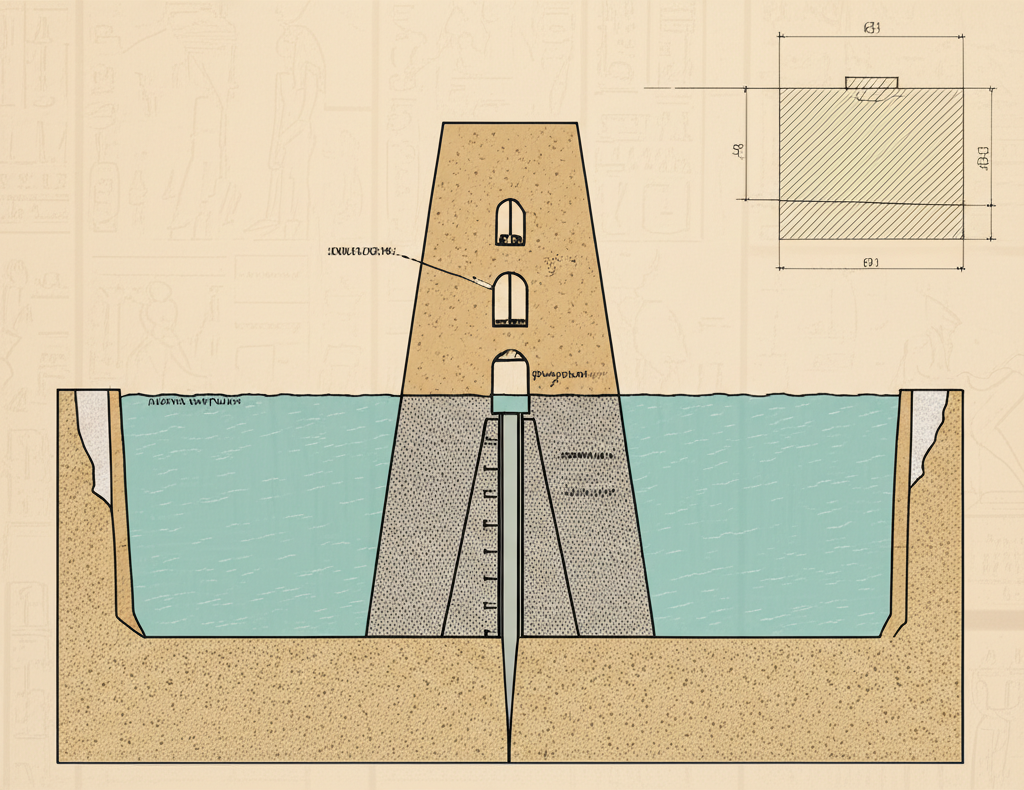
The civilization of Ancient Egypt relied entirely upon the cyclic rhythm of the Nile. To harness this unpredictable force, state engineers developed the Nilometer, a device of distinct structural elegance designed to gauge the annual inundation. These structures were not merely passive observers of the rising waters but sophisticated hydraulic instruments integrated directly into the bedrock of the riverbanks. The strategic placement of these devices allowed the ruling class to translate raw hydrological data into economic foresight.
The architectural design varied between the southern and northern regions, yet the engineering principle remained uniform. The most precise iterations utilized a graduated Column housed within a deep stone well, connected to the river by intake conduits. This design functioned effectively as a stilling chamber, dampening the turbulence of the river’s current to provide an accurate reading of the static water level. Masons carved precise markings into the limestone, measuring the depth in Royal Cubits. This calibration permitted the priesthood to track minute fluctuations in the water table long before the flood reached its zenith.
The data derived from these structures served a critical administrative function beyond simple observation. The recorded height of the floodwaters dictated the projected harvest and, consequently, the calculation of taxes for the coming year. A measurement of sixteen cubits signaled abundance and prosperity, justifying higher levies, whereas lower levels warned of impending drought and famine. Thus, the Nilometer stood as the intersection of engineering and statecraft, where the objective measurement of nature determined the economic stability of the kingdom.