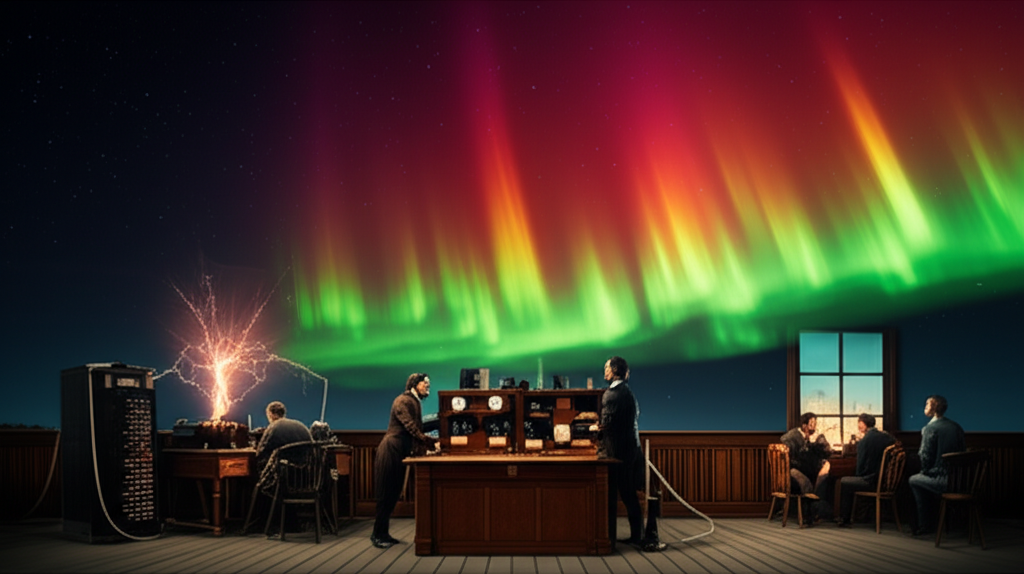
In the annals of solar astronomy and electrical engineering, the Carrington Event of September 1859 stands as the singular benchmark for extreme space weather. Following Richard Carrington’s observation of a massive white-light flare, a Coronal Mass Ejection struck the Earth’s magnetosphere with such velocity that it compressed the magnetic field to a fraction of its normal distance. The resulting geomagnetic storm illuminated the night skies with auroras visible as far south as the Caribbean, yet the true historical significance lay in the disruption of the world’s emerging industrial nervous system.
The global telegraph network, comprising thousands of miles of conductive copper wire, inadvertently functioned as a massive antenna for the changing magnetic fields. Geomagnetically Induced Currents surged through the lines, overwhelming the primitive galvanic batteries used to power the systems. Reports from operators in Boston and Portland documented a remarkable tactical shift: finding their equipment rendered inoperable by the surge, they disconnected the batteries entirely. For a brief window, they successfully transmitted messages utilizing only the celestial energy coursing through the atmosphere.
However, the event was not merely a scientific curiosity but a destructive force. Pylons sparked, telegraph paper caught fire, and operators received physical shocks from their equipment. This crisis highlighted the vulnerability of long-line electrical infrastructure to solar variability. It demonstrated that as humanity extended its reach through wired technology, it simultaneously tethered its operational capacity to the temperaments of the sun. The 1859 storm remains the definitive reference point for analyzing the catastrophic potential of solar superstorms on interconnected grids.