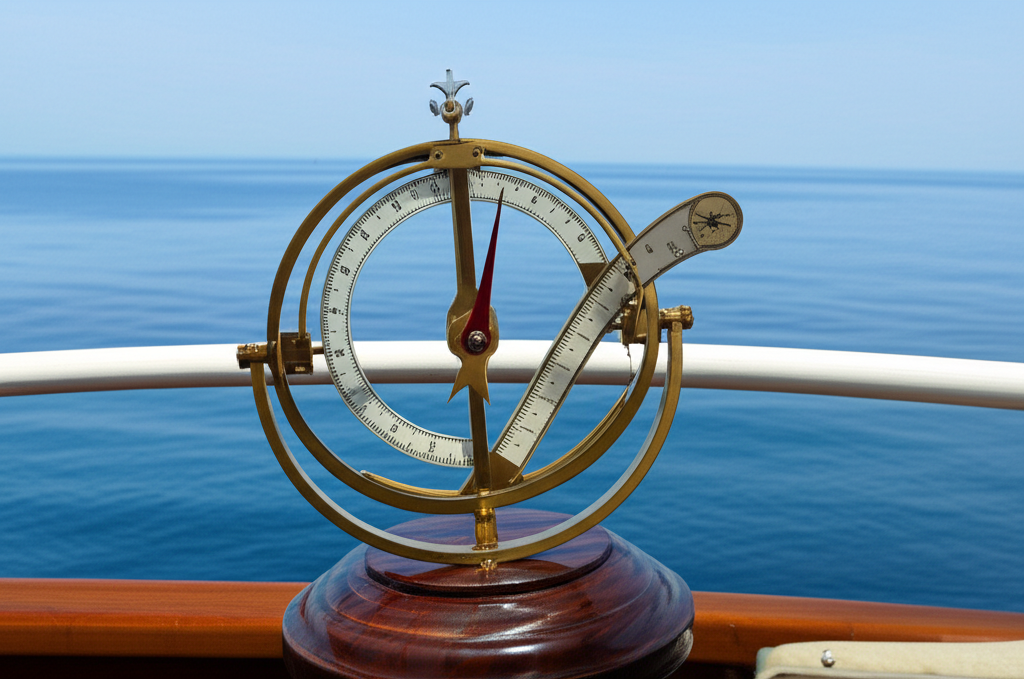
In the annals of maritime navigation, the adoption of the Pelorus marked a significant evolution in an officer’s ability to determine precise headings independent of magnetic distortion. Unlike the standard magnetic compass, which was frequently situated within a protective binnacle and subject to the iron influences of the hull, this instrument served as a “dumb compass.” It possessed no magnetic needle but featured a graduated card aligned specifically with the vessel’s keel. Mariners employed this tool to ascertain relative bearings, effectively decoupling the act of sighting from the fluctuations of the magnetic north.
The strategic utility of the device lay in its optimal placement. Positioned high upon the bridge wings, the Pelorus Stand afforded an unobstructed view of the horizon and celestial bodies, a vantage point often unavailable to the helmsman at the main wheel. This elevation allowed navigators to calculate compass error by comparing observed azimuths against known celestial data. By locking the card to the ship’s course, the observer could relay accurate data to the navigation team, refining the vessel’s trajectory through complex coastal waters without altering the ship’s primary steering gear.
Ultimately, the standardization of this instrument reduced the margin of error in navigational plotting. It transformed the sighting process from a rough estimation into a calculated discipline. The integration of precision Sight Vanes allowed for the sharp delineation of distant landmarks, ensuring that the correlation between the ship’s head and the external reference point remained exact. This development solidified the protocols of piloting, bridging the critical gap between theoretical charting and the physical reality of steering a vessel through the sea.