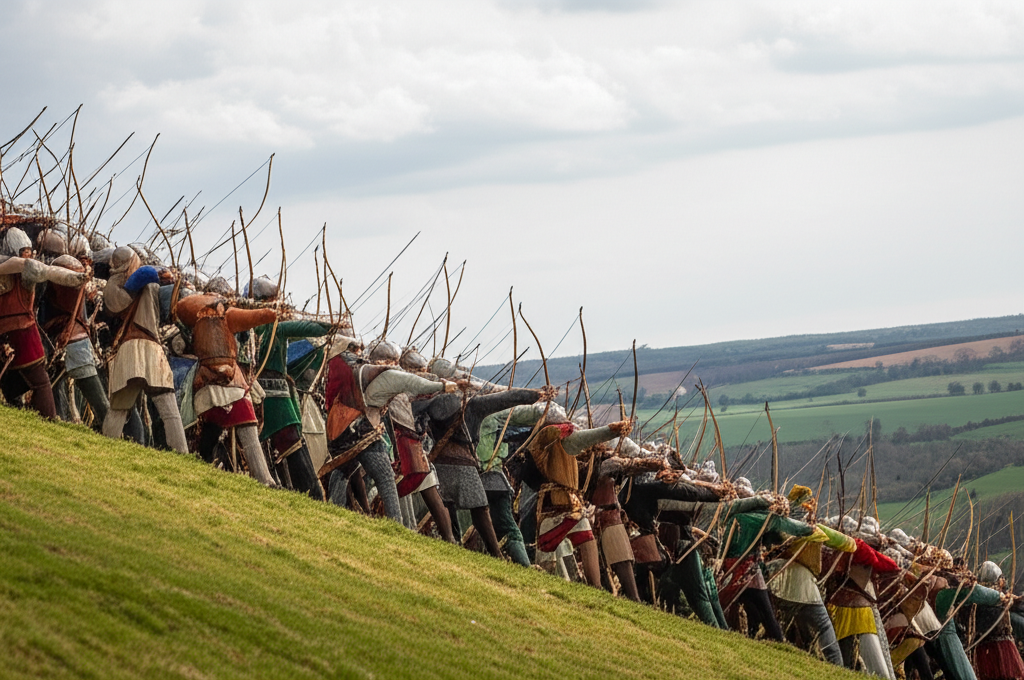
The decisive English victory at the Battle of Crecy in 1346 was a masterful demonstration of tactical innovation centered on the English longbow. King Edward III’s strategy hinged on exploiting the weapon’s full potential through careful preparation of the battlefield. By selecting a defensive position on a downward slope, he forced the French knights to charge uphill, exhausting their mounts and disrupting their formations before they even reached the English lines.
The true genius of the English deployment lay in the arrangement of the archers. They were placed in projecting wedges on the flanks of the dismounted men-at-arms, allowing them to deliver withering enfilading fire into the sides of the dense French columns. This crossfire created a fatal zone from which the attackers could not escape. The archers’ effectiveness was magnified by their disciplined execution of volley fire, a tactic that concentrated thousands of arrows on a single area in a short period.
This sustained “arrow storm” was designed not only to inflict casualties but also to create chaos. The relentless barrage crippled the French advance by injuring and panicking the knights’ warhorses, turning the orderly charge into a disorganized and vulnerable mass. The logistical support, with carts of arrows positioned directly behind the lines for rapid resupply, ensured this immense rate of fire could be maintained. Crecy therefore established a new paradigm in medieval warfare, proving that disciplined missile infantry, properly positioned and supplied, could overcome the shock power of heavy cavalry.