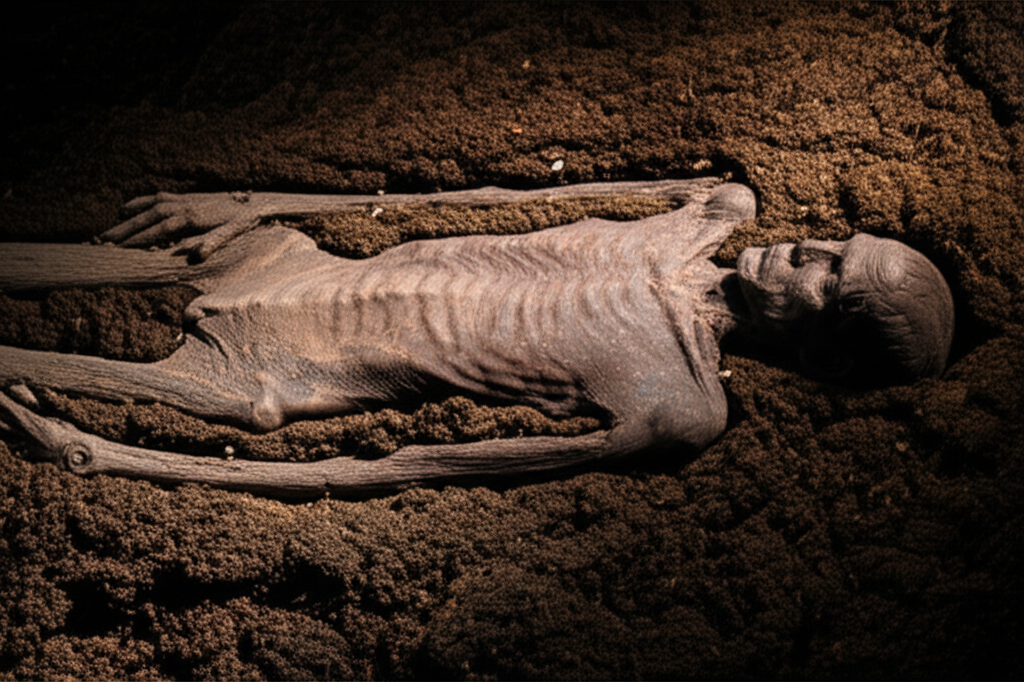
The discovery of Lindow Man in 1984 provided scholars with unprecedented insight into the complex religious mechanics of late Iron Age Britain. Preserved within the peat of Cheshire, the remains offered a grim but invaluable record of a highly structured ritual sacrifice. Rather than an impulsive act of violence, the execution demonstrated a methodical, strategic approach to appeasing the divine during a period of acute societal instability, likely coinciding with the Roman advance.
Forensic analysis of the body revealed a phenomenon scholars term the triple death. The sequence of injuries—severe cranial bludgeoning, garroting, and the severing of the jugular vein—indicated a deliberate, almost procedural execution. This redundancy in lethality was not a matter of mere cruelty, but a calculated ritual necessity. It suggested an optimization of sacrificial practices intended to satisfy multiple deities or to ensure the absolute spiritual efficacy of the offering.
Furthermore, the physical condition of the victim yielded crucial insights regarding the social economy of Iron Age sacrifices. The presence of well-manicured fingernails and the ingestion of a final meal containing mistletoe pollen pointed toward an individual of aristocratic or druidic standing. This elevated status demonstrated a society willing to surrender its elite to the bogs, utilizing its highest-value members to negotiate with the divine.
Ultimately, the remains serve as a profound historical document. The evidence records an era where human sacrifice was enacted not as chaotic savagery, but as a deliberate, highly organized spiritual strategy to maintain cosmic order amidst encroaching existential threats.