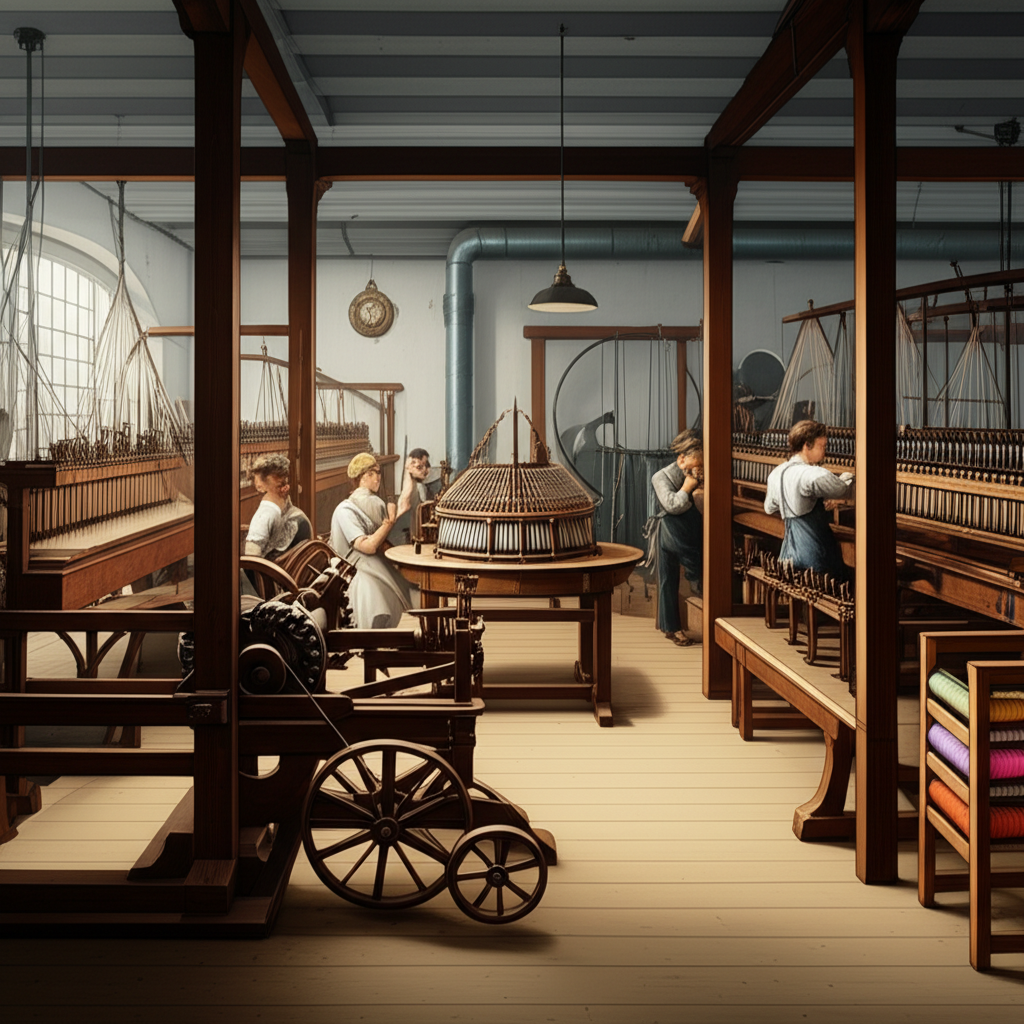
The introduction of the Spinning Jenny in 1764 by James Hargreaves marked a decisive turning point in the annals of industrial history. Prior to this innovation, the Cottage Industry operated within a domestic framework where output was strictly limited by the manual dexterity of individual spinners using single-thread wheels. The strategic significance of Hargreaves’ device lay not merely in its mechanism, but in its ability to multiply human labor; a single operator could now manipulate eight or more spools simultaneously, thereby shattering the production bottlenecks that had long plagued the textile trade.
This exponential increase in yarn production necessitated a fundamental restructuring of the economic landscape. While the initial machines were compact enough for home use, the relentless pursuit of optimization drove the development of larger, more complex iterations. This evolution rendered the domestic workspace obsolete, inevitably shifting the locus of production toward the centralized Factory System. Capital investment became a prerequisite for competitive operation, consolidating power in the hands of industrialists rather than independent artisans.
The transition was neither smooth nor universally welcomed. The displacement of traditional labor provoked severe unrest, as workers recognized that mechanization threatened their livelihood. Despite this resistance, the economic efficiencies introduced by the Spinning Jenny established an irreversible trajectory. It served as the foundational precursor to later innovations, such as the water frame, ultimately cementing the dominance of mechanized production and defining the era of the Industrial Revolution.