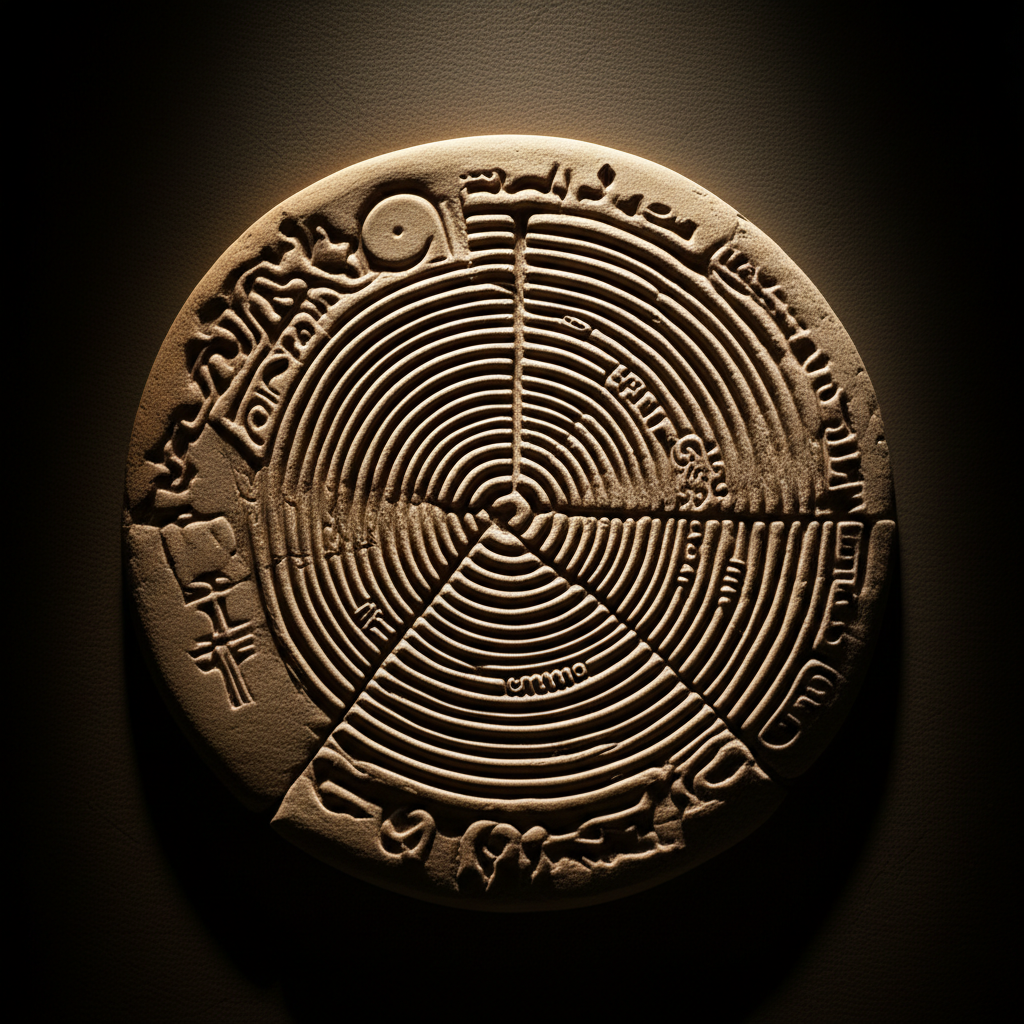
The enigmatic nature of the Phaistos Disc, unearthed in 1908 from the Minoan palace site of Phaistos, continues to defy scholarly decipherment. Its importance lies not only in its uniqueness but also in the strategic challenges it presents to epigraphers. The artifact, a fired clay disc, is imprinted on both sides with a spiral of stamped symbols, a method of production that suggests a level of sophistication beyond simple inscription. The 241 impressions were made using 45 distinct stamps, a quantity that strongly indicates a syllabary rather than an alphabet or a purely logographic system.
Efforts to decode the script have been systematically thwarted by several critical factors. The foremost obstacle is the sheer brevity of the text itself. Without a larger body of work written in the same script, statistical analysis and pattern recognition, which were crucial in deciphering other ancient languages, yield inconclusive results. Furthermore, the absence of any parallel text, or “Rosetta Stone,” leaves no reliable entry point for translation.
The disc remains an isolated linguistic artifact. While found in a Minoan context, its symbols bear no definitive relationship to other Cretan scripts of the era, such as Linear A, which itself remains largely undeciphered. Hypotheses regarding the disc’s content range from a hymn or prayer to a list of military units, yet none can be substantiated without further archaeological discoveries. Until a related text is found, the Phaistos Disc stands as a silent testament to a lost chapter of Bronze Age literacy.