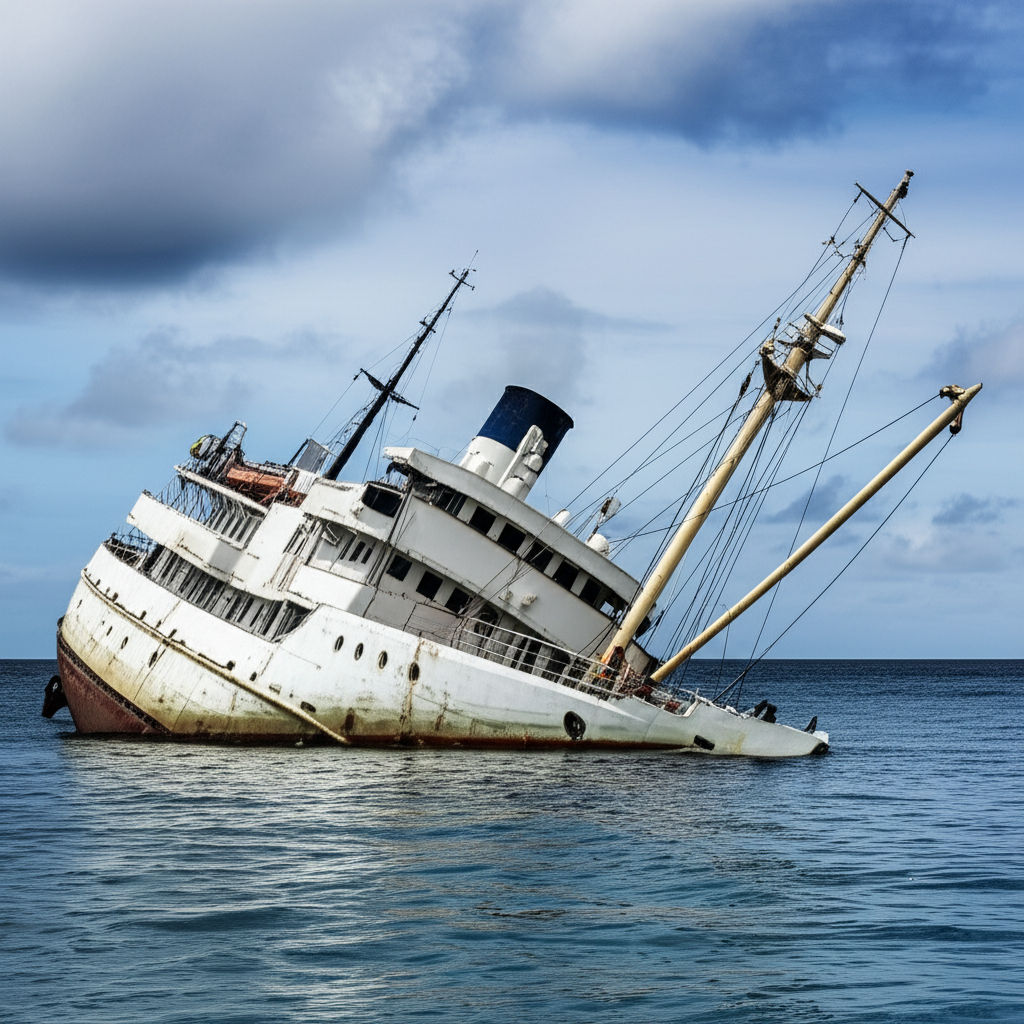
In October 1955, the maritime annals of the South Pacific were marked by the baffling discovery of the merchant vessel MV Joyita. Departing from Apia, Samoa, with a course set for the Tokelau Islands, the ship failed to arrive at its destination, prompting a widespread search. Five weeks later, the vessel was found adrift north of Vanua Levu, Fiji, listing heavily and partially submerged, yet entirely devoid of her twenty-five passengers and crew.
The subsequent inquiry revealed a tragic misalignment between mechanical reality and human psychology. Although the Joyita was structurally unsinkable due to an extensive cork lining within her refrigerated holds, the physical evidence suggests the occupants abandoned the vessel in a state of distress. The cooling pipe of the port engine had fractured, allowing the ocean to flood the bilges. With the pumps inoperable and the ship navigating on a single engine, the situation likely deteriorated rapidly.
Historical analysis posits that the disappearance was not a result of piracy or external hostility, but rather a catastrophic failure of command and judgment. Captain Thomas Miller possessed intimate knowledge of the ship’s buoyancy; however, the discovery of a doctor’s bag on deck containing bloody bandages, alongside missing navigational logs, implies an incapacitating injury to the captain or a mutiny that disrupted the established order.
The fateful decision to deploy the carley floats proved to be the ultimate error. Had the passengers and crew remained aboard the waterlogged hulk, they would have been secured upon the ship’s eventual recovery. Instead, they cast themselves into the open ocean, vanishing without a trace, leaving the Joyita as a silent testament to the perils of panic amidst maritime crisis.