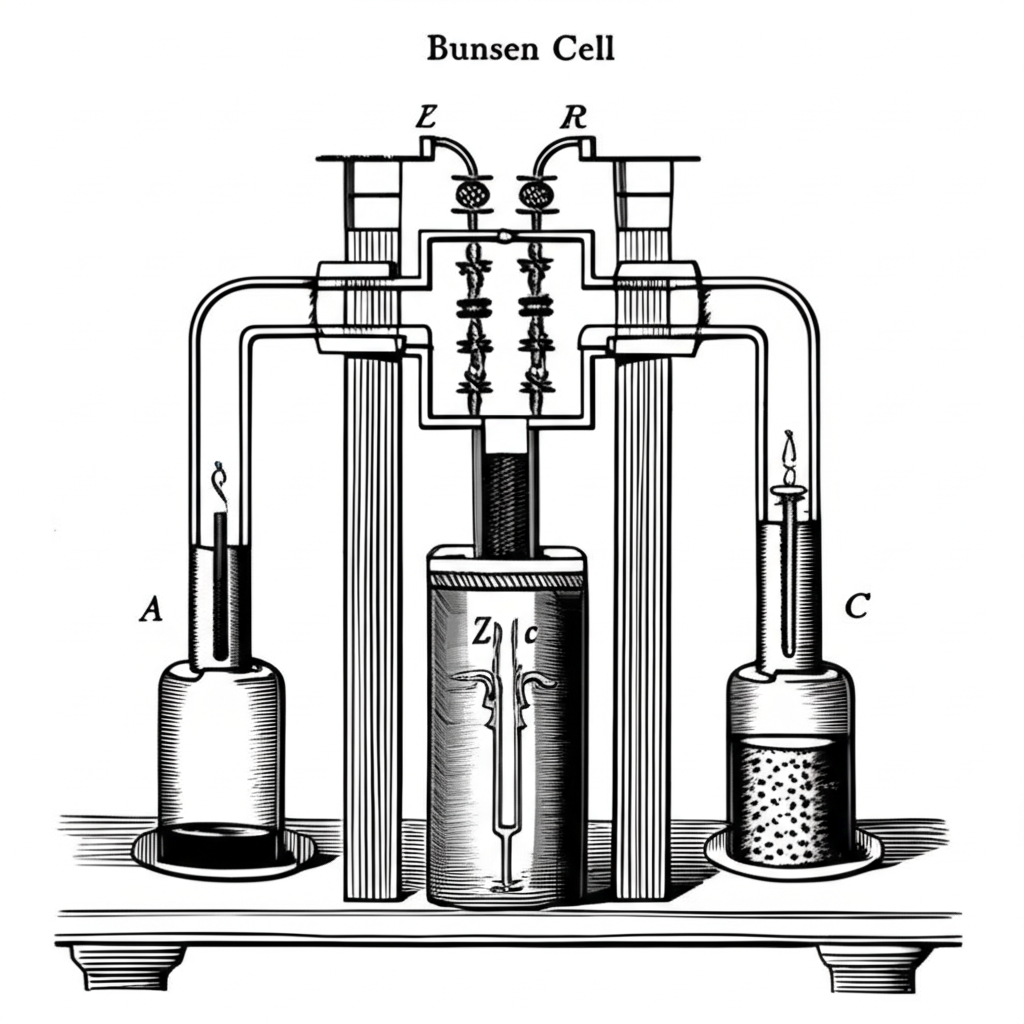
In the annals of early electrochemistry, the year 1841 marked a pivotal shift in power generation with the introduction of the Bunsen Cell. Prior to this development, the Grove Cell, invented by William Grove, offered substantial voltage but suffered from a prohibitive economic constraint: the reliance on a platinum cathode. Robert Bunsen, recognizing that the cost of noble metals hindered the widespread industrial application of voltaic piles, sought a material alternative that retained high conductivity without the exorbitant expense. His strategic substitution of carbon for platinum fundamentally altered the trajectory of battery production.
The architecture of Bunsen’s device remained similar to its predecessor, utilizing a Zinc Anode immersed in dilute sulfuric acid and separated by a porous ceramic vessel. However, the innovation lay within the inner compartment, where a rod of pressed coal or coke served as the cathode submerged in concentrated nitric acid. This configuration not only maintained a high electromotive force of approximately 1.9 volts but also effectively managed polarization. The nitric acid acted as a robust depolarizer, reacting with hydrogen to prevent gas bubbles from insulating the electrode, thereby sustaining a steady and powerful current for prolonged periods.
By reducing capital costs, the Bunsen cell facilitated the expansion of energy-intensive applications previously deemed impractical. It became the preferred power source for early Carbon Arc Lighting and large-scale electroplating operations during the mid-19th century. While the device was celebrated for its consistent output and economic efficiency, it was not without hazards; the reduction of nitric acid released noxious nitrogen dioxide fumes, necessitating the operation of these batteries in well-ventilated environments. Nevertheless, this optimization bridged the critical gap between laboratory curiosity and industrial utility.