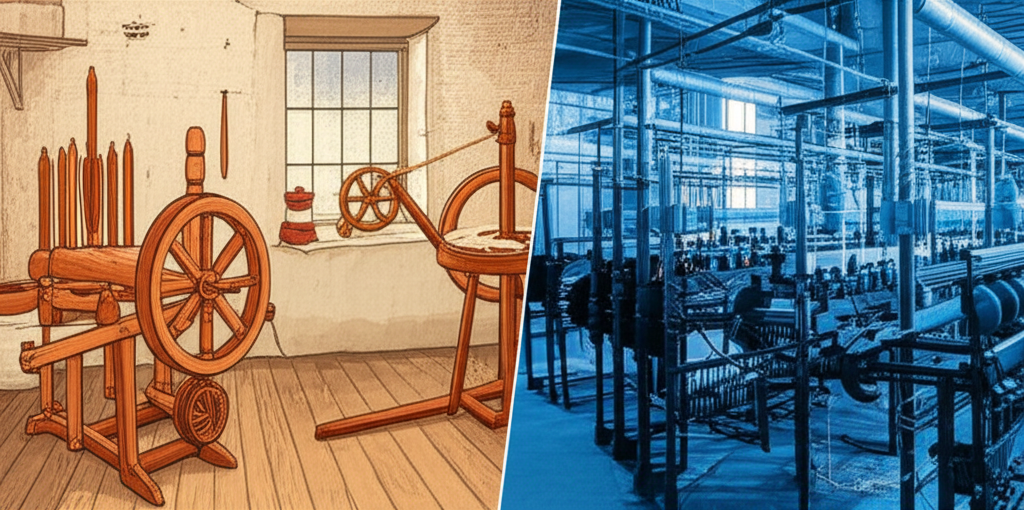
The invention of Samuel Crompton’s Spinning Mule in 1779 was a pivotal development that precipitated the end of the traditional cottage industry for textile production. Prior to this innovation, spinning was a decentralized, domestic enterprise. The Spinning Mule, however, represented a technological leap that could not be contained within a home-based system.
The machine’s strategic advantage was its ability to produce high-quality, fine, and strong yarn in quantities far exceeding what was possible with earlier devices like the spinning jenny. This superior efficiency immediately rendered the output of cottage spinners economically unviable. Furthermore, the scale and complexity of the Mule grew rapidly. Later versions were too large and expensive for individual households and required a non-human power source, such as a water wheel or steam engine, to operate effectively.
This technological imperative forced a fundamental reorganization of production. Capital was consolidated to build and equip centralized mills capable of housing and powering numerous machines. Consequently, labor was drawn from rural homes into these burgeoning industrial centers. The Spinning Mule did not merely improve upon an existing system; its operational requirements dismantled the cottage industry by making centralized factory production the only competitive model for manufacturing textiles on a commercial scale.