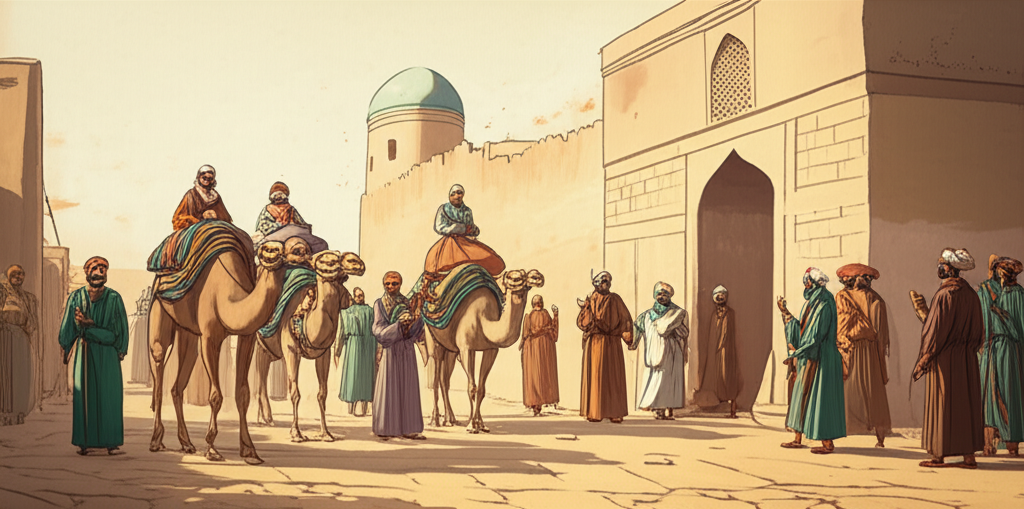
The Sogdian people, originating from the fertile lands of Transoxiana, established themselves as the indispensable intermediaries of transcontinental commerce during late antiquity and the early Middle Ages. While distinct empires claimed political dominion over the Eurasian steppes, these merchants constructed a commercial empire based not on territorial conquest, but on strategic connectivity. Their centrality to the Silk Road was not merely a consequence of geography; it was the result of calculated diplomatic and economic structures that effectively bridged the cultural and logistical divide between the Mediterranean and East Asia.
The operational success of the Sogdian network relied heavily on the mastery of information and diaspora management. Operating from major urban hubs like Samarkand and Bukhara, they established a chain of commercial colonies extending deep into the Chinese interior and across the northern steppes. These enclaves functioned as self-governing nodes, facilitating the secure movement of luxury commodities such as raw silk, musk, and precious metals. Consequently, the Sogdian language evolved into the lingua franca of the trade routes, serving as the essential administrative medium for the Turkic Khaganates and the diplomatic channels of the Tang Dynasty.
Beyond mere economics, their strategic utility involved complex cultural brokerage. Sogdian traders acted as the primary vectors for the transmission of Manichaeism, Buddhism, and Nestorian Christianity across Asia. Their astute management of symbiotic relationships with nomadic protectors allowed them to monopolize long-distance exchange where others failed. Although their influence eventually waned following the An Lushan Rebellion, historical analysis confirms that for centuries, the structural integrity of Eurasian trade depended entirely upon the extensive kinship networks and financial acumen of these merchant communities.