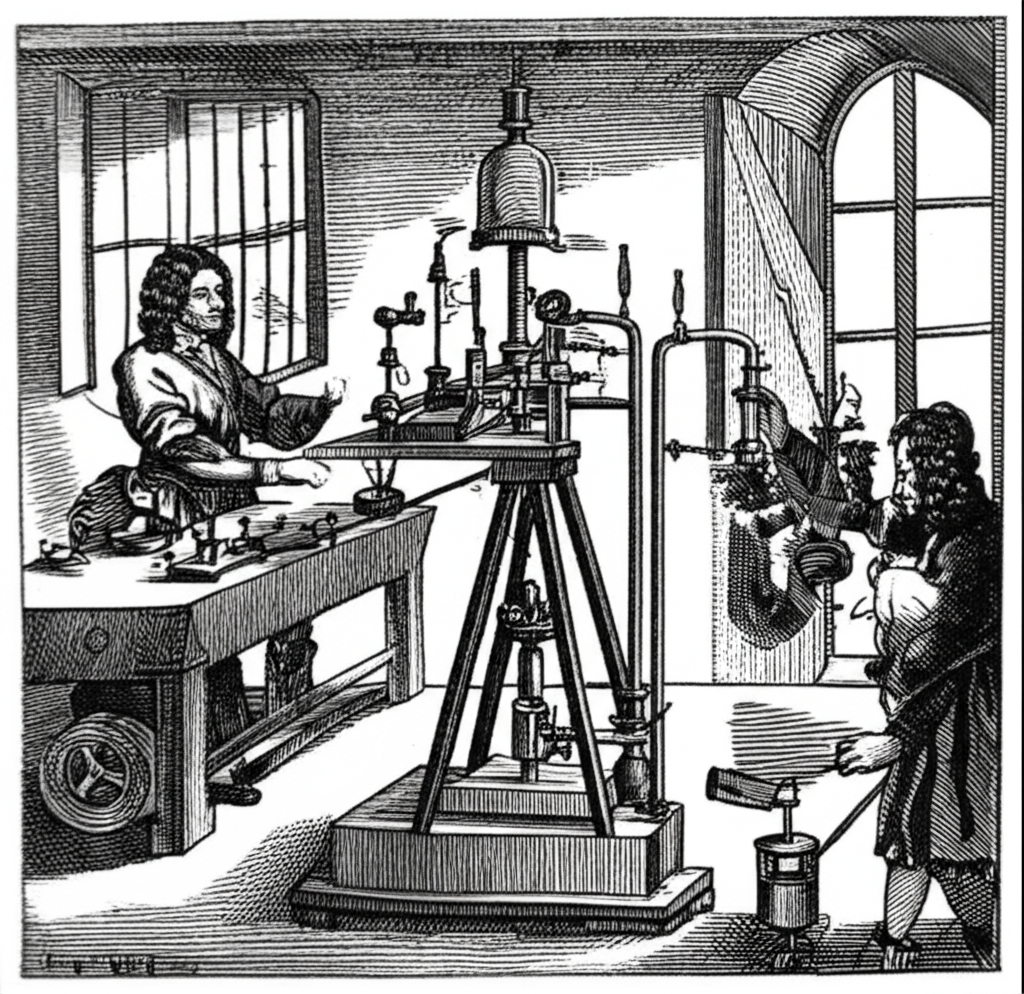
In the mid-17th century, the debate surrounding the existence of a vacuum was largely a philosophical matter. Robert Boyle sought to resolve this through empirical evidence, a strategy that required an instrument capable of creating and sustaining a void. This necessity led to the creation of the air pump, a device that would become central to the new experimental science.
While Boyle is credited with the invention, the practical design and construction were executed by the brilliant instrument-maker Robert Hooke around 1659. Their collaborative effort produced what was then called a pneumatic engine, a machine with a large glass receiver from which air could be progressively removed by a piston. This apparatus was a significant improvement upon earlier, less reliable models and was specifically engineered for systematic investigation.
The strategic importance of the air pump cannot be overstated. It was not merely an invention but a powerful research tool that transformed abstract speculation into observable phenomena. With it, Boyle conducted a series of methodical experiments demonstrating the physical properties of air, including its elasticity and essential role in combustion and respiration. These carefully documented procedures, which ultimately led to the formulation of Boyle’s Law, established a new standard for scientific inquiry, proving that purpose-built instrumentation was essential for unlocking the secrets of the natural world.